
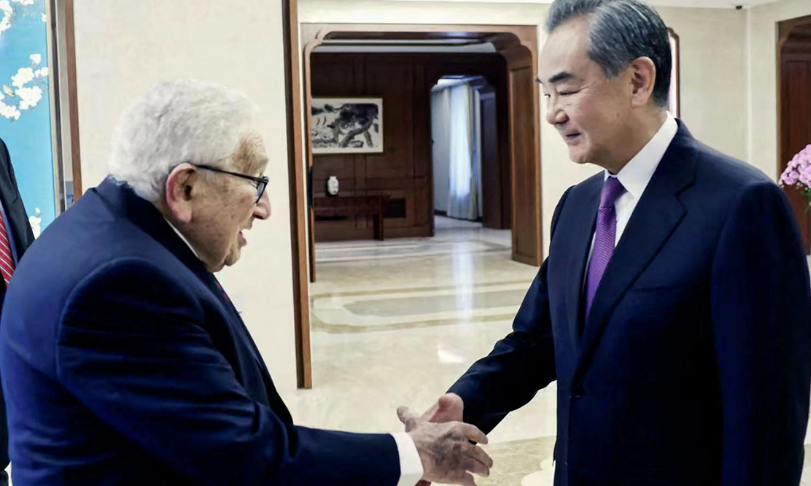

During US climate envoy John Kerry’s visit to China, Chinese senior diplomat Wang Yi met with centenarian former US Secretary of State Henry Kissinger in Beijing. Kissinger, regarded as an old friend of the Chinese people due to his historic contributions to China-US relations, engaged in discussions with Wang Yi about the current state of bilateral relations. Wang Yi urged the US government to reconsider its current policy towards China, which he characterized as one of containment and suppression.
The meeting between Wang Yi and Kissinger comes as part of a series of high-level interactions between China and the US, following visits from US Secretary of State Antony Blinken and US Treasury Secretary Janet Yellen. These interactions indicate a growing effort to resume constructive dialogue between the two countries, as bilateral relations have reached a historical low point due to various issues, including the Taiwan question and mishandling of incidents involving China.
Wang Yi praised Kissinger’s role in enhancing mutual understanding between China and the US, highlighting the importance of mutual respect, peaceful coexistence, and win-win cooperation in dealing with each other correctly. He emphasized that China’s development is driven by internal forces and historical logic, making it impossible for external attempts to transform or contain the country. Wang Yi called for US policies towards China to exhibit the wisdom of Kissinger and the political courage of former President Nixon, conveying a clear message to the Biden administration that China expects a shift in its policy.
Experts see the resumption of high-level communication as a positive sign, suggesting an effort to bring divergences under control and prevent further derailment of bilateral relations. Some experts even speculate that these interactions may pave the way for a potential meeting between the two heads of state during the G20 Leaders’ Summit or APEC Economic Leaders’ Meeting in the second half of 2023. However, uncertainties remain about the long-term trajectory of bilateral relations, as domestic politics in the US continue to pose challenges, making significant policy changes unlikely.
Kissinger’s visit, while not yielding immediate outcomes, plays a role in maintaining communication channels and paving the way for future talks. It comes amidst a suspension of military-to-military communication between China and the US since US House Speaker Nancy Pelosi’s visit to Taiwan in August 2022. Kissinger’s unofficial role may help clear some obstacles and facilitate possible future discussions on military and security issues.
In addition to the diplomatic engagements, Kerry also met with China’s Vice President Han Zheng to discuss climate change. Despite diplomatic difficulties in recent years, both countries acknowledged the importance of treating the climate issue as a stand-alone challenge and emphasized the need for collective efforts to address it. China reiterated its commitment to the Paris Agreement and expressed readiness to seek common ground with the US.
The revival of climate cooperation between the world’s two largest economies is seen as a positive step towards increasing mutual trust and dispelling doubts. China has consistently played an active role in fulfilling its climate change commitments, while the US has been inconsistent with its policies, especially during the Trump administration. The success of future climate cooperation depends on the US’ commitment and actions towards meeting these goals.
Although climate change is a significant topic in US-China relations, it cannot be entirely separated from the overall bilateral relationship. Kerry’s visit aimed to re-establish channels of communication on climate issues and gain a better understanding of China’s principles and bottom-line. This knowledge will assist the Biden administration in reviewing future climate cooperation with China.