
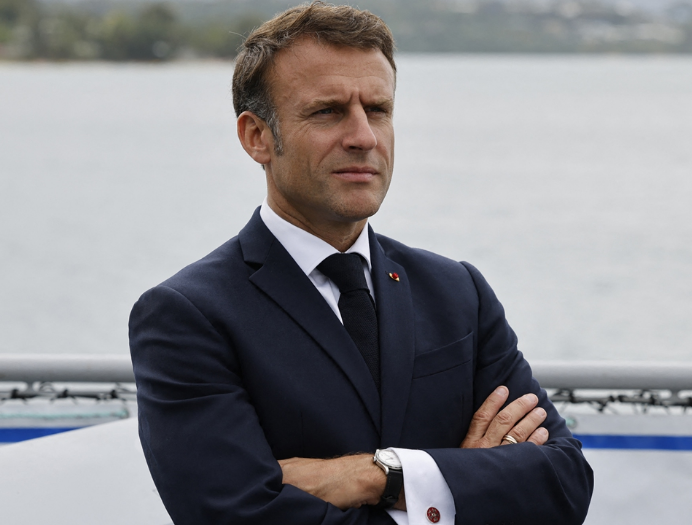

French President Emmanuel Macron recently voiced concerns about the emergence of so-called “new imperialism” in the South Pacific during his five-day visit to the region, which includes stops in New Caledonia and Papua New Guinea. This visit marks the first time a French president has traveled to independent countries in the Pacific, highlighting France’s perceived importance in the region.
Western media have attributed the “new imperialism” label to both China and the US, given the growing competition between these two countries in the area. However, Chinese experts strongly disagree with placing China in the same category as the hegemonic US, describing the label as an empty concept used by Macron to attack others in an effort to bolster France’s standing in the Pacific region.
China emphasizes that its actions in the region are aimed at assisting with development rather than pursuing imperialist ambitions. Experts question why France did not actively help regional countries develop earlier and have reservations about France’s colonial past, which could be difficult for Macron to rationalize. Instead of addressing this issue, Macron seems to divert attention by criticizing other countries, particularly China and the US, according to Chinese experts.
During his visit, Macron mentioned increasing French forces in New Caledonia and warned against the possibility of a “Chinese naval base tomorrow” if the region were to pursue independence. He reaffirmed France’s presence and influence in the Pacific and Oceania.
China and the US have been engaged in competition in the South Pacific, and some French observers view this as a contest between old and new forms of hegemony. However, Chinese experts argue that this perspective is limited and fails to understand China’s genuine efforts to promote regional development.
The US has previously attempted to use the narrative of “China’s military base in Solomon Islands” to deter South Pacific countries from cooperating with China, and Macron’s remarks are seen as following this line of thinking, according to Chinese experts.
In recent years, some Western countries have used accusations of “new imperialism” and “neo-colonialism” to smear China’s international cooperation efforts, particularly in regions like Africa, the Middle East, and Southeast Asia. Chinese experts point out that such comparisons are improper and ridiculous, as they judge China based on the actions of old imperialist countries in the past.