
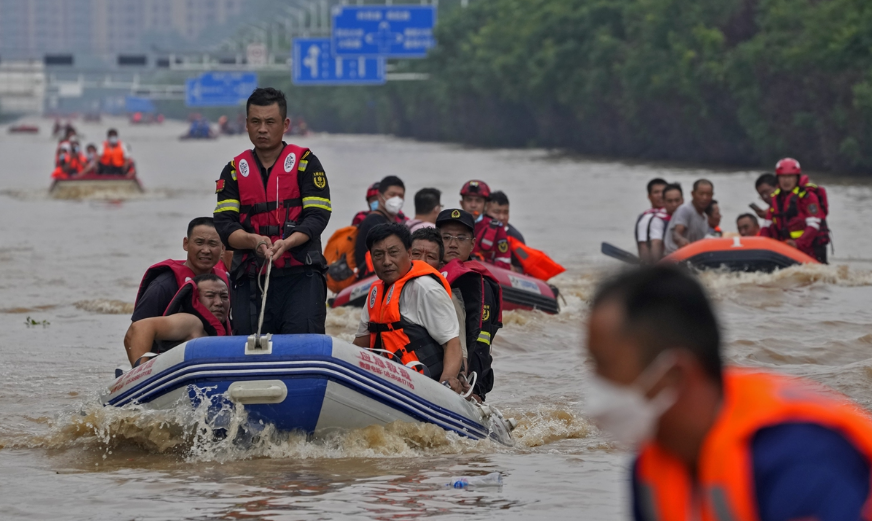

Over the past two days, more than 1,000 rescue teams have been dispatched to Zhuozhou to assist in relief efforts. While the eastern parts of the city have seen some improvement, floodwaters still persist in the western areas, leaving some residents stranded and awaiting rescue as of Wednesday afternoon.
Local officials reported that from 8 am on Saturday to 11 am on Tuesday, Zhuozhou experienced relentless heavy rainfall, with an average precipitation of 355.1 millimeters. This resulted in significant impacts on the region, affecting 133,913 people from 146 villages, covering an area of 225.38 square kilometers. As a consequence, the citywide water supply was cut off, and power outages affected certain areas.
Amid the crisis, evacuation efforts have been underway, with 125,100 people from 124 villages safely moved to secure locations. Zhuozhou has organized 28 emergency rescue teams comprising 8,755 members, who are collaborating with various professional rescue squads, including the Blue Sky Rescue Team, a civil relief group from China.
The situation has been dire for many residents and villagers who lost cell phone connections, hindering their ability to seek help. An online help form indicated that those stranded urgently required essential supplies such as dry food, water, and medication. Communication problems and power outages have exacerbated the situation, making it difficult for individuals to maintain contact with their loved ones.
Besides the human impact, Zhuozhou’s significance as a logistics hub city has also taken a severe hit. Numerous publishing house book warehouses have been flooded, potentially affecting millions of books. Additionally, some logistics group transshipment warehouses in the city have been impacted by the floods.
A resident named Wang, who shared a video with Global Times, described how water levels had flooded streets and submerged cars. Although the rain had ceased on Wednesday morning, the water level was receding slowly. Wang also mentioned that residents in the western part of Zhuozhou, where the damage was more severe, were given only a day’s notice to evacuate, leaving many without sufficient time to escape the flooding.
The situation in Zhuozhou has garnered widespread concern and worry. Rescue teams from various cities and provinces have rushed to assist, but some encountered delays in entering the city due to incomplete formalities. However, these issues were eventually resolved by the early hours of Wednesday morning.
Despite the challenges, rescue efforts are ongoing, with volunteers like Yan Shi from Zhuozhou joining in to help their fellow citizens. A civil rescue team from East China’s Shandong reported that they successfully arrived in Zhuozhou on Wednesday morning, and their operations proceeded smoothly on the way to the affected city.
“We departed from Beijing’s Fangshan district at about 4 am and arrived in Zhuozhou at 6 am,” the rescuer, surnamed Hua, said.
“The highway was toll-free all the way. There were individuals to guide us when we got off the highway. Local government officials showed us the way, and there were people in charge of food, accommodation and drinking water for the rescue teams.”
Hua’s team, the Weifang Thunder Rescue Team, took part in the rescue in Fangshan on Tuesday and rushed to Zhuozhou after the situation in Beijing improved. They had been working non-stop for 24 hours.
The water level in the eastern parts of Zhuozhou was no longer rising, and the evacuation of trapped people was almost complete, Hua told the Global Times.
The streets of Zhuozhou were almost full of rescue teams, with at least 1,000 teams arriving in the city, he said.
In the western parts of Zhuozhou, which were even more severely affected, Zhang Baowei, a member of the Heze Luying Disaster Relief Public Welfare Association who traveled from Shandong, told the Global Times Wednesday afternoon that although the rain had stopped, the water level was still slowly rising and communications were not very good.
“On Wednesday morning alone, I received over 300 calls for help,” Zhang said, adding that there were still trapped people in western Zhuozhou who have not been rescued.
These civilian rescue teams have encountered some difficult situations in Zhuozhou, especially in terms of equipment.
The Luying team’s rescue boat is underpowered, so it is unable to carry people forward when it encounters rapids. Moreover, there was a shortage of fuel for the rescue boat. The life jackets of the Thunder rescue team were not were not resistant enough to rapids and the rescue boat’s material was not durable enough for the situation.
Hua also said that some trapped people, especially the elderly, were reluctant to be transferred because they felt there was no need to leave as they still had food at home.
Yan and some Zhuozhou residents who volunteered for the rescue operation also said their specialized equipment was insufficient, and the undercurrent in the water further affected rescues.
“Even with insufficient equipment, we are trying to save as many people as possible,” Yan said.
“Because I am a Zhuozhou local, I want to do something that a Zhuozhou local should do.”
Hebei had reported nine deaths and six missing as of noon on Tuesday.
China has allocated 110 million yuan ($15.43m) to support flood prevention and disaster relief work in Beijing, Tianjin, and Hebei, according to the Ministry of Finance and the Ministry of Emergency Management on Tuesday. On Wednesday, the Organization Department of the Communist Party of China (CPC) Central Committee allocated 44 million yuan ($6.17m) in funds to assist with flood control and disaster relief work in the region.