
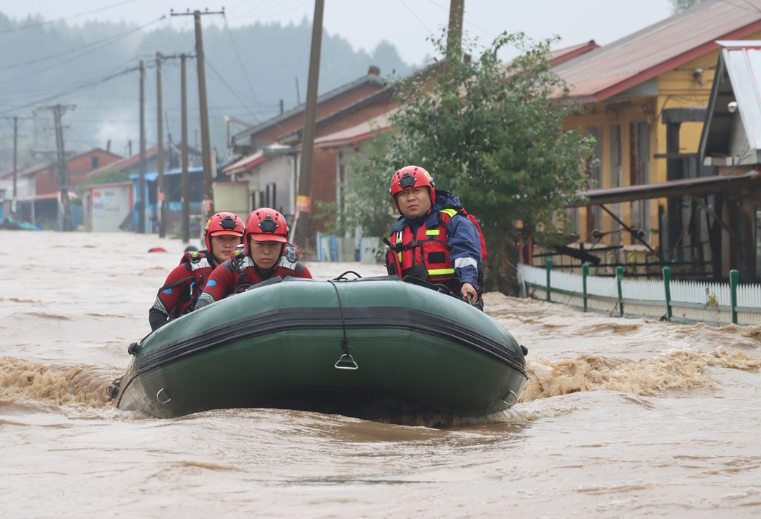

China’s Ministry of Emergency Management and the National Commission of Disaster Reduction initiated a national Level IV disaster relief emergency response on Friday night in response to the devastating rainstorm and flood disasters in Heilongjiang Province, Northeast China. The authorities deployed a working group to guide and support local authorities in their disaster relief efforts.
The disaster has affected 21 counties, cities, and districts in the cities of Harbin, Mudanjiang, Yichun, and Qiqihar in Heilongjiang Province. Harbin and Mudanjiang have experienced more serious flood disasters. As a result, Heilongjiang’s disaster reduction authorities declared a provincial Level III response to natural disaster relief on Friday night.
As of Saturday morning, 25 rivers, including the Lalin River and Mudan River, have surpassed water warning levels by 0.06-3.40 meters, with five rivers exceeding the guaranteed water level. The Mudan River (Station 2), Mayi River (Yanshou Station), and Lalin River (Wuchang Station) have all exceeded water warning levels and reached flooding levels due to sustained rainfall.
The situation is critical, with the Mayi River and Lalin River experiencing the severest floods in 50 years. Several large, medium, and small reservoirs in Heilongjiang have also exceeded flood limits by 0.04-4.84 meters.
The flooding has led to serious consequences, with areas like Shangzhi and Wuchang suffering from severe flooding, rice fields being submerged, and houses being washed away. In response, Heilongjiang has issued red alerts for meteorological risks of geological disasters and further rainstorms.
Efforts are underway to mitigate the impact, with Wuchang city safely evacuating over 20,000 residents from high-risk areas. However, the floods are likely to have significant economic consequences, particularly in Wuchang, known for its rice production, as the area’s rice planting constitutes a significant portion of the province’s total.
In response to the unprecedented rainfall, Shangzhi city has suspended classes, work, production, operation, and business on Saturday, as the city experiences its largest rainfall since 1957. The situation remains challenging, and authorities are closely monitoring the developments to ensure the safety and well-being of affected communities.