
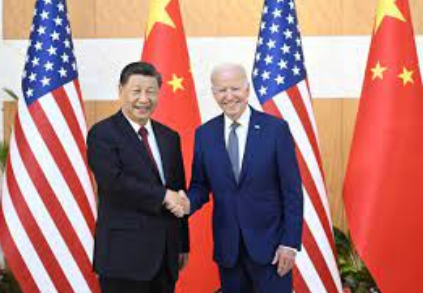

In a recent development reported by the Financial Times, China and the US are set to open new lines of communication to address contentious issues. Under this potential mechanism, both countries are likely to engage in discussions about South China Sea matters, broader maritime issues, economic and trade concerns, and other issues of mutual interest. The establishment of these communication channels is expected to help prevent misjudgments and ease tensions between the two global powers.
According to the FT report, Washington and Beijing will create two working groups, with one focusing on Asia-Pacific regional issues and maritime concerns, and a possible third group focusing on broader areas. The details are expected to be fleshed out in the coming months, though it has not reached a final decision yet, as cautioned by a source.
Li Haidong, a professor at China Foreign Affairs University, emphasized that such communication channels can effectively prevent misjudgment and misunderstandings, which have been significant challenges in the current China policy of the US. The visits by senior US officials to China and the establishment of these working groups signal that despite the difficult moment in bilateral relations, the handling of the relationship is gradually maturing and entering a relatively predictable stage.
Uncertainty and lack of mutual trust have been major hurdles impacting China-US relations, preventing deeper cooperation in various fields. Constructing communication channels will help build trust in certain areas, making the relationship between the two countries more effective.
While the communication channels are being established, the US continues to be provocative and aggressive towards China on several matters, including the sensitive Taiwan question. The US has recently announced the provision of military assistance worth approximately $345 million to Taiwan. However, Lü Xiang, a research fellow at the Chinese Academy of Social Sciences, believes that the Taiwan issue may not be the topic discussed through the communication channels. The framework on the Taiwan question has been set by the three joint communiques between China and the US, leaving no room for ambiguity.
Li suggested that economic and trade issues, responses to climate change, and national defense and security issues could be discussed. The South China Sea issue may also be on the agenda, with possibilities of negotiations over the rules of encounter between the Chinese and American militaries in the region. Additionally, cybersecurity, US technology restrictions on China, and its crackdown on Chinese enterprises could be subjects for discussion in the hope of correcting excessive and wrongful actions by the US.
When addressing concerns raised by Republicans in Congress about resurrecting high-level interactions with Beijing, Lü pointed out that the Biden administration tends to use Congress to stonewall some issues, but in foreign policy, if there is no overwhelming congressional opposition, the administration can typically make its own decisions.
“I believe that Biden from the day he took office, he has sufficient resources and rights to reverse the deterioration in China-US relations. But it is a pity that Biden and his diplomatic team have made the wrong decisions in reinforcing some of the policies from the Trump era,” Lü said.
“I don’t think it’s too late for Washington to fix these issues and improve ties ,” he noted.