
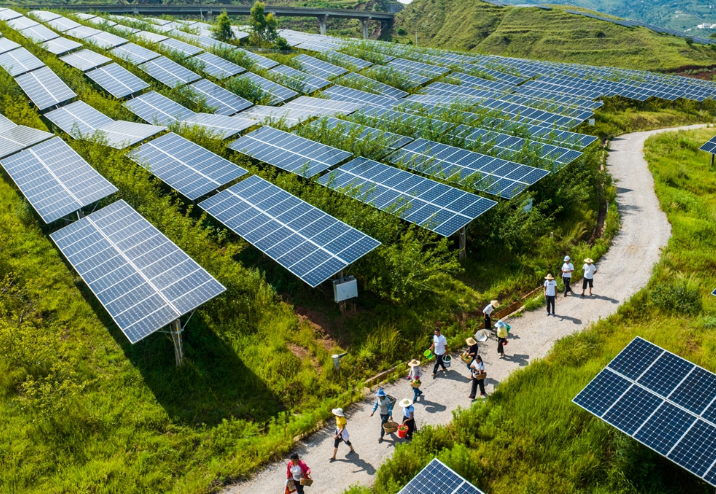

The US Commerce Department has issued a final determination on Friday, confirming that five Chinese solar panel companies have been evading anti-dumping and countervailing duties by rerouting their operations through Southeast Asian countries. This decision comes in the wake of a preliminary finding made in December that had already ruled against four Chinese firms. While the final ruling was expected, it underscores the intensifying efforts by the US to tighten the reins on China’s clean-energy sector, according to Chinese experts.
The stringent measures imposed by the US not only cast uncertainty over China’s clean-energy industry but also bear far-reaching repercussions for global industrial and supply chains.
The recent determination reveals that subsidiaries of Chinese companies BYD, Trina Solar, Vina Solar, and Canadian Solar were sidestepping US tariffs by engaging in minimal processing to complete their products in Cambodia, Malaysia, Thailand, and Vietnam, before exporting them to the US. These four nations collectively contribute to around 80 percent of the US panel supplies.
New East Solar is also slated to face tariffs since the company declined to cooperate with an on-site audit of its operations in Cambodia, according to a senior US official as reported by Reuters.
The US investigation was set in motion following a complaint by the US-based company Auxin Solar. In response to this investigation, a spokesperson from the Chinese Foreign Ministry conveyed in March 2022 that the US’ trade protectionism would disrupt global industrial supply chains and hinder collaboration on climate change, terming these measures as an economic boomerang that would eventually harm the US.
Although the US has employed protectionist measures in the past to support the growth of its domestic industries, these suppressive tactics are increasingly unpopular, even within the US. This comes at a time when the Biden administration has outlined ambitious clean-energy objectives, according to an industrial analyst named Wang.
Abigail Ross Hopper, President and CEO of the Solar Energy Industries Association, criticized the impact of the inquiries, asserting that Auxin Solar’s allegations lacked merit and that they have created instability in the US market, particularly when the solar energy sector is gaining momentum. Hopper stated that the final determinations exacerbate existing supply issues due to a scarcity of domestic cell and module supply.
Despite the final ruling, the imposition of duties may be deferred until June 2024. This two-year delay aims to ensure sufficient panel inventory while domestic manufacturing capacity grows, as per the Biden administration’s two-year waiver.
Wang pointed out that China has gained a competitive edge in terms of production costs, efficiency, and technological innovation in the photovoltaic sector. Therefore, the US pursuit of “decoupling” from China within the global new energy industrial chain could result in more financial stress and obstacles for its own new-energy development.
China’s solar sector has demonstrated resilience against the long-standing US pressure and has made substantial strides in the international market. Despite the US imposing anti-dumping and countervailing duties on Chinese solar products since 2012, the past decade has seen China’s solar industry grow stronger rather than weaken.
China has consistently held the world’s top position in newly added photovoltaic installed capacity for a decade, with a cumulative installed capacity surpassing 470 million kilowatts in the first half of this year, according to Li Chuangjun, director of the Department of New Energy and Renewable Energy Sources of the National Energy Administration.
In 2022, China’s export of photovoltaic products surged by 80.3 percent year-on-year to reach $51.25 billion, based on data from the China Photovoltaic Industry Association.
Confronting the assertive US suppression, China is poised to leverage legal avenues to protect its legitimate interests while strengthening its quality and exports in strategically important markets like Europe. This approach aims to bolster China’s comparative advantages in the photovoltaic and clean-energy sectors.