
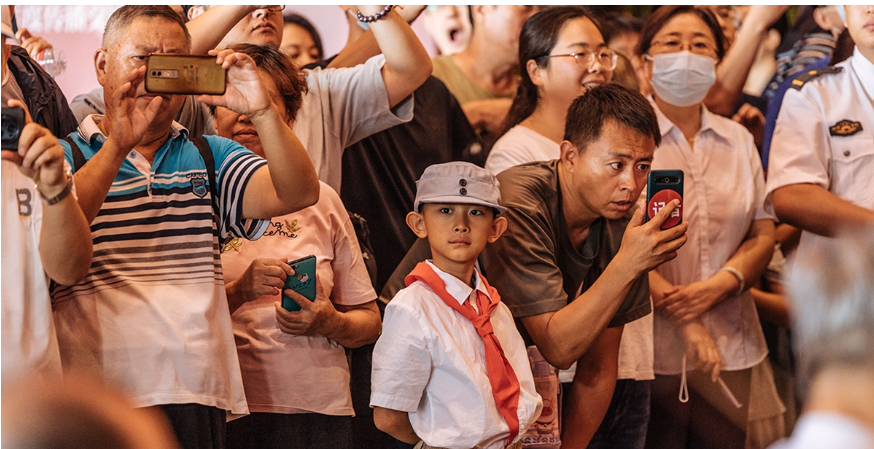

On the 78th anniversary of the victory in the Chinese People’s War of Resistance Against Japanese Aggression and the World Anti-Fascist War, commemorations took place across China to honor the martyrs and reflect on the hard-fought peace achieved.
China’s War of Resistance Against Japanese Aggression, lasting from 1931 to 1945, was the longest, largest, and most costly national liberation war in modern Chinese history. It marked the first complete victory by the Chinese people in their struggle for national liberation and played a pivotal role in the global fight against fascism.
In Beijing, a symposium attended by approximately 200 officials, including Li Shulei, a member of the Political Bureau of the Communist Party of China (CPC) Central Committee and head of the Publicity Department of the CPC Central Committee, emphasized the significance of this victory and how it restored China’s status as a major world power, earning respect from peace-loving people worldwide.
The Museum of the War of Chinese People’s Resistance Against Japanese Aggression hosted exhibitions highlighting China’s leading role in opening the global anti-fascist war, thwarting Germany and Japan’s plot to divide the world, and becoming a crucial force in the Asia-Pacific region. One exhibition featured the Jin-Cha-Ji (Shanxi-Chahar-Hebei) Pictorial, the first comprehensive publication founded by the CPC in 1942, which documented China’s resolute resistance against Japanese invaders.
Descendants of survivors of the Nanjing Massacre, representatives of the Chinese People’s Liberation Army, and youth representatives gathered at the Memorial Hall of the Victims of the Nanjing Massacre by Japanese Invaders in Nanjing. They paid tribute to the martyrs and commemorated the victory symbolized by the iron-red wall at the memorial hall’s square.
In Jiujiang, new recruits volunteering for the PLA honored martyrs, while in Changzhi, middle school students offered flower baskets to revolutionary heroes at a monument.
Liu Jiangyong, a vice dean of the Institute of Modern International Relations at Tsinghua University, stressed the importance of remembering this period of history, as it holds practical significance for contemporary international relations. He warned of the risk of certain countries initiating new wars to assert global dominance through military power.
Liu pointed to Japan, which released a new National Security Strategy in 2022 designating China as the “greatest strategic challenge.” He argued that Japan’s shift away from peaceful development should be a cause for concern, especially considering its military buildup in the East Asia region.
As China commemorates its victory over aggression and fascism, the international community is urged to remain vigilant against the resurgence of militarism and to work toward maintaining peace and preventing the recurrence of world wars.