
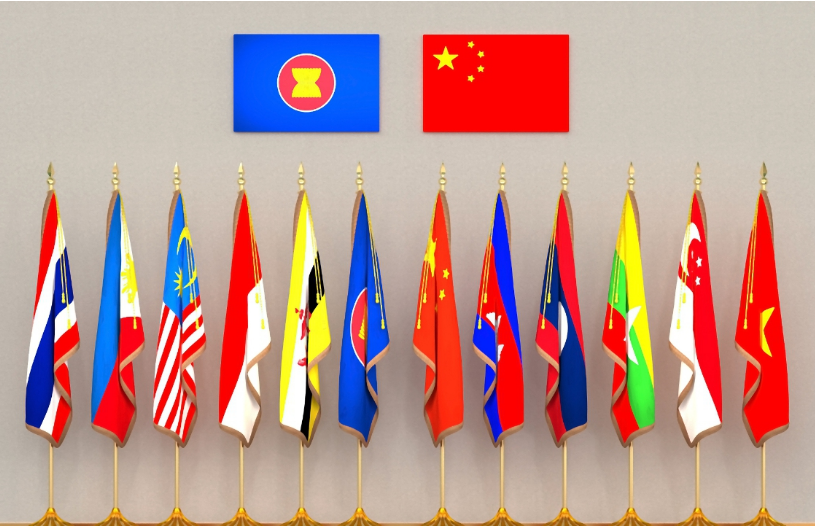

Leaders from ASEAN member countries and dialogue partner nations have convened in Jakarta for the 43rd ASEAN Summit and related meetings, held from Tuesday to Thursday. While geopolitical tensions and disputes are present, the focus of the summit remains on dialogue, cooperation, and peaceful development, particularly in the context of Asia’s role in global economic growth.
Notably, the United States has chosen to send Vice President Kamala Harris to the summit, signaling its priorities in the region. Leaders from countries including China, Japan, South Korea, Australia, Canada, and organizations such as the UN and the EU are attending this significant diplomatic event in Southeast Asia.
Chinese Premier Li Qiang is set to participate in various summits during his visit, including the 26th China-ASEAN Summit, the 26th ASEAN Plus Three (APT) Summit, and the 18th East Asia Summit. He will also embark on an official visit to Indonesia, marking his first visit to an Asian country since taking office, coinciding with the 10th anniversary of the bilateral comprehensive strategic partnership.
The theme of this year’s ASEAN Summit is “ASEAN Matters: Epicentrum of Growth.” Leaders are expected to discuss strengthening ASEAN integration and expanding collaboration, particularly in areas such as the digital and green economies.
Xu Liping, Director of the Center for Southeast Asian Studies at the Chinese Academy of Social Sciences, emphasized that amid rising geopolitical tensions, ASEAN prioritizes economic growth and cooperation over political and security matters. The group seeks to avoid taking sides between major powers and prioritizes regional integration and collaboration. China is actively working with ASEAN countries to foster economic growth and closer friendship through people-to-people exchanges.
Regarding disputes in the South China Sea, both parties emphasize that it should be resolved through dialogue among involved parties, and any actions that escalate tensions and endanger peace should be opposed. Chinese Foreign Minister Wang Yi reiterated China’s commitment to the Declaration on the Conduct of Parties in the South China Sea and the early establishment of a “Code of Conduct.” Wang emphasized the shared goal of transforming the South China Sea into a region of peace, friendship, and cooperation.
Despite potentially contentious topics on the agenda, ASEAN has maintained its centrality and resilience over more than half a century of development. Analysts believe that ASEAN will not be easily manipulated by the U.S. to serve its “Indo-Pacific Strategy” targeting China. The U.S., focusing on bilateral and “small-multilateral” formats, has opted not to attend the ASEAN Summit, with Vice President Kamala Harris representing the nation instead. The U.S. aims to prevent ASEAN integration, preferring a fragmented ASEAN that aligns with its interests.
While some regional countries may lean toward the U.S., analysts caution that increasing dependence on the U.S. could lead to chaos and conflicts in the region, negatively impacting Asia-Pacific countries. The summit’s discussions and outcomes will shed light on ASEAN’s commitment to cooperation and peaceful development amid complex geopolitical dynamics.