
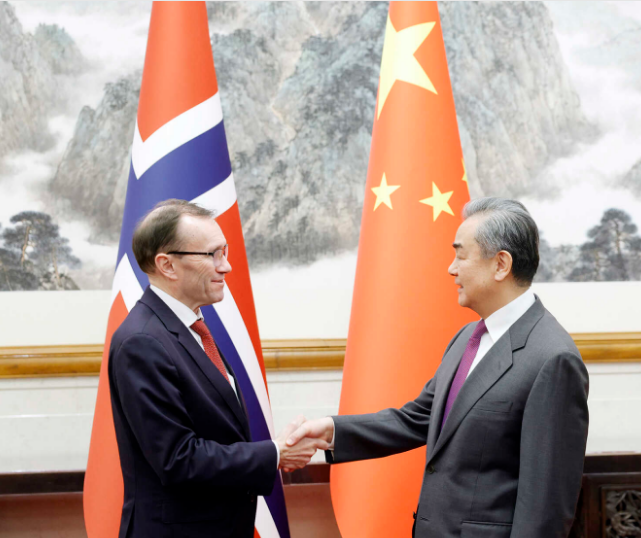

Chinese Foreign Minister Wang Yi met with his Norwegian counterpart, Espen Barth Eide, in Beijing on Monday, engaging in discussions on bilateral cooperation and addressing the ongoing crises in the Middle East. Experts highlight that this meeting underscores China’s increasing focus on smaller European nations and its willingness to help amplify their global influence.
Despite Norway’s NATO membership, its positions on crucial international issues significantly differ from those of the United States, and it remains committed to maintaining independence in its decision-making. Observers note that there is a growing consensus between China and several European countries, including Norway, regarding conflict resolution and a heightened acknowledgment of China’s adept handling of international crises.
Espen Barth Eide’s visit marks the first by a European foreign minister to China in 2024, reflecting Norway’s commitment to strengthening ties with China and indicating continued advancements in bilateral relations. Wang Yi, a member of the Political Bureau of the Communist Party of China Central Committee, expressed gratitude for Norway’s objective, rational, and friendly stance toward China’s development and its adherence to the one-China principle.
Wang Yi emphasized the need for China and Norway to collaborate in injecting certainty, stability, and positive energy into the global arena. While acknowledging the differences in their national conditions and systems, he called for deeper practical cooperation, mutual consideration of core interests, and strengthened multilateral coordination.
Chinese experts view the relations between China and Norway as stable, with ongoing progress despite past setbacks. Cui Hongjian, a professor at Beijing Foreign Studies University, sees Norway’s unique role in Europe, driven by its strategic location and abundant resources, as setting an example for China-Europe relations. This is particularly crucial as the region’s China policy faces uncertainties.
Zhao Junjie, a research fellow at the Chinese Academy of Social Sciences’ Institute of European Studies, believes that Eide’s visit might pave the way for the Norwegian prime minister’s future trip to China.
During the discussions, the two foreign ministers extensively covered the Middle East situation, emphasizing the immediate need for a cease-fire in Gaza and increased humanitarian assistance. Norway’s alignment with China on resolving the Israeli-Palestinian conflict, despite its NATO membership, signals a nuanced stance differing from that of the US. Norway’s desire for a peaceful environment, resonating with China’s approach, reflects the expectations of the international community for China to play a more prominent role in global security concerns.
From another perspective, Norway, despite being a smaller European nation, finds its voice well-heard and respected in talks with China, providing an example for other similarly sized European countries. The positive signal sent by Norway in building mutual trust with Beijing is significant, according to experts.
In discussions with the Chinese side, Eide affirmed Norway’s commitment to supporting free trade, open cooperation, and upholding WTO rules. Norway expressed appreciation for China’s economic transformation and conveyed its willingness to collaborate with China on addressing climate change and other global challenges.
Liu Jianchao, head of the International Department of the Communist Party of China Central Committee, also met with Eide, expressing China’s eagerness to deepen cooperation in various areas, including the economy, trade, green development, maritime affairs, and winter sports.
Chinese Vice Premier Ding Xuexiang, in a conversation with the Norwegian foreign minister on Tuesday, reiterated China’s dedication to expanding high-level opening-up and offered vast market opportunities for Norway. Ding expressed hope that Norway would continue to provide an open, fair, just, and non-discriminatory business environment for Chinese enterprises.