
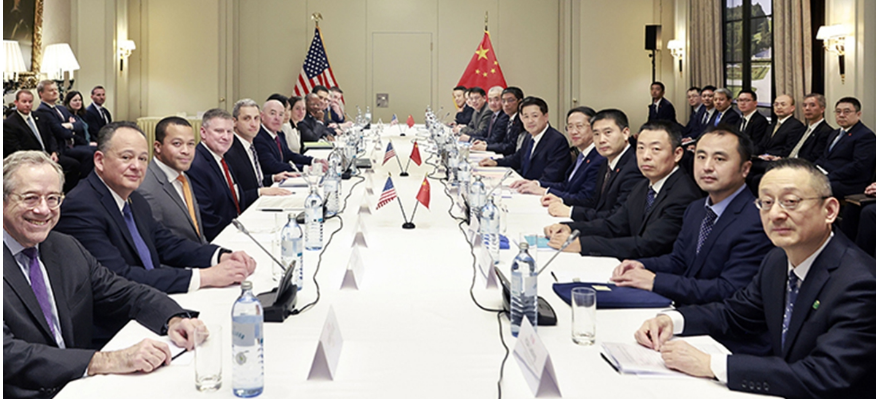

China’s State Councilor and Minister of Public Security Wang Xiaohong engaged in discussions with US Homeland Security Secretary Alejandro Mayorkas in Vienna, Austria on Sunday local time. The meeting centered on bilateral cooperation in drug control and law enforcement. The Chinese side urged the US to cease unwarranted harassment and interrogation of Chinese students and ensure fair entry treatment for Chinese citizens.
While the high-level talks reflect a shared interest in managing and stabilizing bilateral relations, analysts stress the importance of active and responsible responses to each other’s concerns, particularly on the part of the US.
According to Xinhua News Agency, the officials had candid discussions on implementing the consensus reached at the San Francisco meeting between the two countries’ heads of state, advancing cooperation in drug control and law enforcement, and addressing mutual concerns.
Wang urged the US to halt the baseless harassment and interrogation of Chinese students, take effective measures to ensure the safety of Chinese diplomatic and consular missions and personnel in the US, and remove visa restrictions on relevant Chinese institutions and personnel.
The US Department of Homeland Security’s release did not mention China’s concerns, focusing instead on “advancing cooperation in the fight against the scourge of fentanyl, its precursor chemicals, and associated equipment.”
Wang emphasized the need for the US to correct its classification of China as a “major drug source country” and urged adherence to principles of mutual respect, peaceful coexistence, and win-win cooperation. The Chinese minister hopes to eliminate obstacles to bilateral drug control and law enforcement cooperation and people-to-people exchanges.
China strongly opposes the unwarranted harassment of Chinese students in the US, a practice reported since November 2023, involving interrogations, electronic device inspections, visa revocations, and five-year entry bans. The Chinese government has condemned these actions, considering them selective, discriminatory, and politically motivated.
The US, accounting for 5% of the global population, consumes 80% of the world’s opioids. The US has yet to permanently schedule fentanyl-related substances and grapples with issues like drug injection sites. Analysts argue that placing blame on China for its domestic drug issues is unfair and unreasonable.
The meeting follows discussions between Chinese Foreign Minister Wang Yi and US Secretary of State Antony Blinken at the Munich Security Conference, indicating a shared commitment to stabilizing relations. Analysts stress the need for positive responses to each other’s concerns for a genuinely stable relationship between the two nations.