
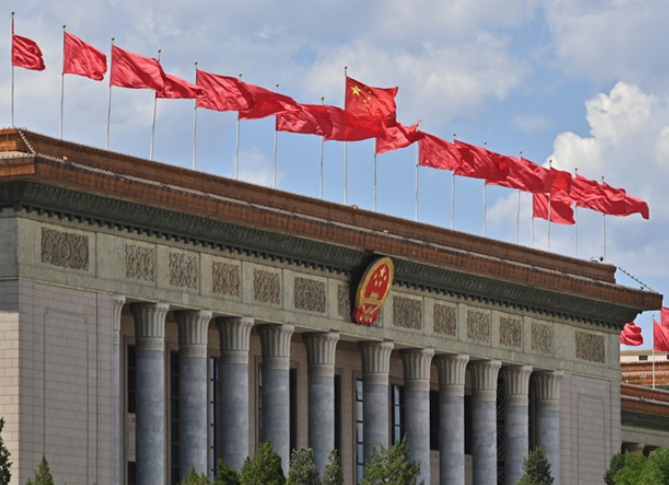

As China enters the crucial two sessions period on Monday, the world’s attention is directed toward one of the nation’s most significant political events. The second session of the 14th National People’s Congress (NPC) is set to commence on March 5 in Beijing, while the second session of the 14th National Committee of the Chinese People’s Political Consultative Conference (CPPCC) will start on March 4. These sessions play a pivotal role in outlining China’s priorities and plans for 2024, encompassing the economy, diplomacy, military, and social development.
In the 75th anniversary year of the People’s Republic of China and amid the implementation of the national 14th Five-Year Plan (2021-25), the two sessions are poised to send a resounding message to the world. China aims to reinforce its commitment to fostering global common development and prosperity through high-quality development.
During the two sessions, Chinese policymakers will unveil social and economic development goals for the year, including the annual GDP growth target, accompanied by policies to achieve these objectives. With over 3,000 reporters from around the globe ready to cover the event, foreign media outlets are speculating on the revealed targets and policies. This anticipation is particularly high regarding new productive forces and reforms in key sectors, such as the financial industry, which are expected to provide fresh growth momentum.
In the face of multiple global risks and challenges, including economic uncertainties, geopolitical tensions, and emerging issues like artificial intelligence and climate change, the international community looks to China for answers that can inject certainty and new growth impetus into the world economy.
Helga Zepp-LaRouche, founder of the Schiller Institute, expressed hope that the two sessions would address strategic challenges based on President Xi Jinping’s vision of a shared future for humanity. She emphasized the importance of overcoming the notion that countries must defend their interests against others by any means necessary.
Wirun Phichaiwongphakdee, director of the Thailand-China Research Center of the Belt and Road Initiative, highlighted the significance of learning about China’s economic direction and policies in 2024. This information is crucial for shaping economic and trade cooperation between China and other Asian countries, especially those in Southeast Asia.
China’s advancements in artificial intelligence and its role as the world’s second-largest economy have positioned it as a significant global player. Analysts predict that China’s innovations in AI will contribute to global development, making the upcoming two sessions a focal point for insights into the country’s economic and technological direction.
As the world awaits the outcomes of the two sessions, expectations include discussions on the Belt and Road Initiative, high-level opening-up policies, and opportunities for foreign companies in China’s evolving business environment. Foreign enterprises operating in China are particularly interested in policies related to carbon neutrality, healthcare, the digital economy, and AI.
With China’s consumption sector rebounding and macroeconomic policies intensifying, the country is anticipated to play a crucial role as an engine for global economic growth. As discussions unfold during the two sessions, it is expected that China will further outline its economic goals and strategies for 2024, providing direction for both domestic and international stakeholders.
Analysts foresee a focus on new productive forces, emphasizing high technology, efficiency, and quality. Innovation, as a core element, is crucial for developing these new forces and supporting high-quality economic growth. The emphasis on regulatory innovation and creating a favorable business environment for enterprises, especially private companies, is expected to drive breakthroughs in new productive forces.
Despite short-term challenges and fluctuations, China’s resilient economy, coupled with policy adjustments and strengthened regulations, is positioned to overcome obstacles. The confidence stems from the people-centered development approach and the centralized leadership of the Communist Party of China (CPC) with President Xi at the core. China’s economic growth of 5.2 percent in 2023 underscores its resilience and potential in the post-COVID-19 era.