
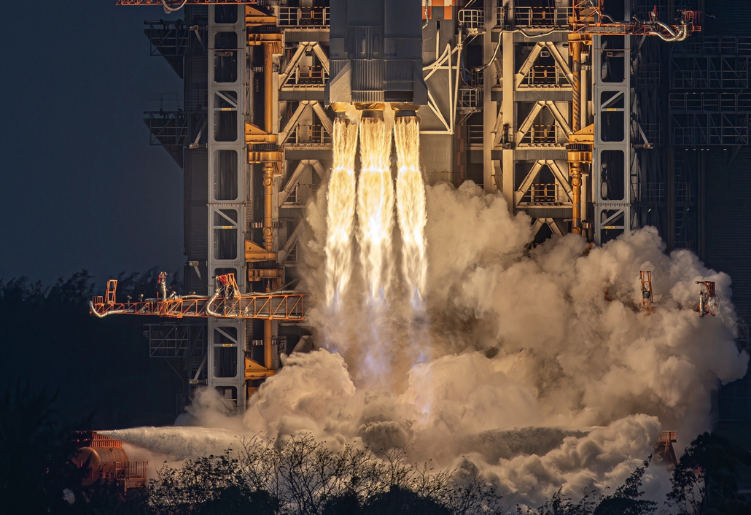

China achieved a significant milestone on Wednesday with the successful launch of the Queqiao-2 relay communication satellite along with the Tiandu-1 and Tiandu-2 communication and navigation technology experiment satellites. These satellites constitute a crucial constellation supporting China’s forthcoming Chang’e lunar exploration missions and international exploration endeavors.
The Long March-8 rocket, carrying the three satellites, lifted off from the Wenchang Space Launch Site in South China’s Hainan Province at approximately 8:31 am on Wednesday. After a flight of 24 minutes, the Queqiao-2 satellite separated from the carrier rocket, with its solar wings and communication antennas deploying as planned, marking the mission’s success, according to the China National Space Administration (CNSA).
Queqiao-2, also known as Magpie Bridge-2, functions as a relay satellite facilitating communications between the far side of the moon and Earth. It will play a vital role in supporting China’s upcoming lunar exploration missions, including Chang’e-4, Chang’e-6, Chang’e-7, and Long March-8 missions.
The Tiandu-1 and Tiandu-2 satellites, which separated from the Queqiao-2 relay satellite shortly after launch, entered a direct Earth-moon transfer orbit. These satellites, developed by the Shanghai Academy of Spaceflight Technology and the Harbin Institute of Technology, will undergo mid-course corrections and near-moon braking to enter a capture orbit, followed by a 24-hour period elliptical lunar orbit.
During their mission, the Tiandu satellites will conduct various technology verifications, including lunar orbit navigation and high-reliability transmission between the moon and Earth. The successful launch of these satellites marks a significant advancement in China’s space exploration capabilities.
The Long March-8 rocket, specifically tailored for the Queqiao-2 mission, demonstrated enhanced trajectory design, flexible active roll control technology, and improved thermal protection measures. Developed by the China Academy of Launch Vehicle Technology (CALT), the Long March-8 rocket has proven its stability, reliability, and adaptability in previous missions.
With its ability to carry payloads to Earth-moon transfer orbit, the Long March-8 rocket is poised to meet future demands for launching large-scale constellations in low Earth orbit. Its successful performance in Wednesday’s mission underscores its significance in advancing China’s space exploration endeavors.
China’s upcoming Chang’e-6 mission, scheduled for the first half of this year, aims to further enhance lunar exploration capabilities and scientific collaboration on an international scale. With plans for future missions, China is set to bolster its position in planetary exploration and space launch capabilities over the next 15 years, according to Wu Weiren, chief designer for China’s lunar exploration program.