
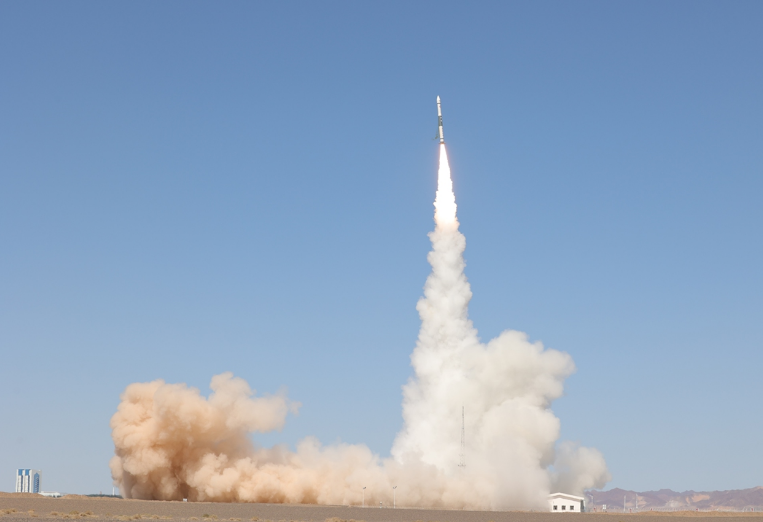

According to Hubei Sanjiang Group, a wholly-owned subsidiary of China Aerospace Science and Industry Corporation (CASIC) and the developers of the Kuaizhou rockets, plans are underway for eight to 10 orbital launches in 2024, aiming to deploy over 30 satellites into their designated orbits.
In a recent interview, the firm disclosed that it has commissioned two types of commercial rockets, Kuaizhou-1A and Kuaizhou-11, for these launch missions.
The Kuaizhou rockets have garnered recognition for their consistent strides in independent innovation. Being the solid carrier rocket with the highest number of launches and consecutive successful launches in China, they’ve earned the moniker “gold-medal rocket” within the industry.
Kuaizhou-1A has already completed 26 launches, placing 56 satellites into their designated orbits to date, encompassing various types such as remote sensing, navigation enhancement, communication, and scientific experiments. Meanwhile, Kuaizhou-11 had its maiden flight on December 7, 2022.
Developers highlight that Kuaizhou-1A holds the record for the highest number of launches among Chinese rockets and boasts leading network efficiency. Notably, it set a record in 2019 for consecutive launches within six hours at the Taiyuan Satellite Launch Center.
These rockets’ precise launches have enabled a range of applications, including high-precision Earth imaging, meteorological detection, navigation system augmentation, and scientific exploration in orbit. These efforts contribute to resource integration across various sectors such as national land monitoring, mineral resource development, smart city construction, and public health emergency response.
Highlighting their efficiency, the Kuaizhou-1A rockets were launched continuously in groups from March 22, 2023, to January 5, 2024, facilitating the rapid formation of the Tianmu-1 sun-synchronous orbit constellation within 360 days, setting a domestic commercial satellite constellation network formation record.
Moreover, significant strides have been made in reusable technology, with the successful completion of tests for a 70-ton reusable liquid oxygen methane engine and vertical takeoff and vertical landing (VTVL) tests by the Kuaizhou team.
The establishment of the Kuaizhou Rocket Industrial Park in Wuhan National Aerospace Industry Base further underscores China’s commitment to aerospace development. With solid and liquid carrier rocket core test capabilities and an annual assembly and testing capacity of 20 to 50 carrier rockets, the park aims to drive innovation and attract enterprises to the aerospace industry chain.