
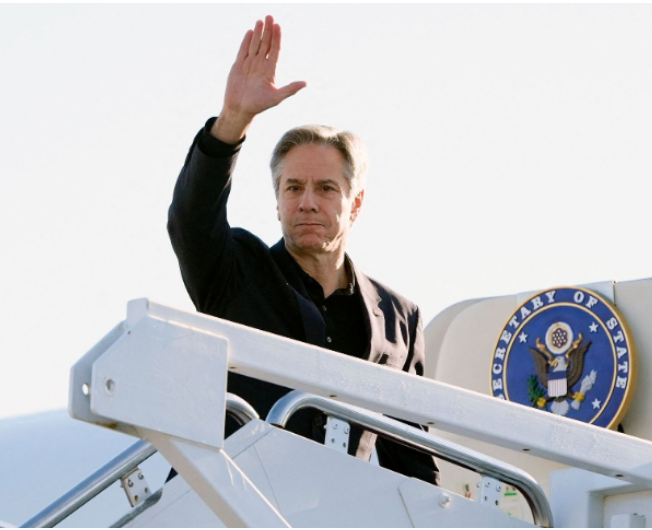

US Secretary of State Antony Blinken arrived in Shanghai on Wednesday afternoon, marking the beginning of his second official visit to China. The visit is seen by some Chinese experts as indicative of Washington’s desire to foster cooperation with Beijing, with the potential to achieve breakthroughs contingent upon the US’ mindset and approach.
However, amid ongoing signals of pressure from the US for concessions, experts express skepticism regarding the likelihood of a positive outcome from Blinken’s visit to China.
During his trip from Wednesday to Friday, Blinken is scheduled to engage in discussions with senior Chinese officials in both Shanghai and Beijing on various bilateral, regional, and global issues, as per a statement issued by the US State Department.
Western media outlets also approach the visit cautiously. The New York Times warns of potential trouble ahead, while Reuters highlights a range of unresolved issues casting a shadow over bilateral ties.
Major divisions between China and the US, including the Russia-Ukraine conflict, tensions in the Middle East, the Taiwan question, and the South China Sea issue, are anticipated topics of discussion during Blinken’s visit, as outlined by the Associated Press.
In anticipation of Blinken’s arrival, China’s Ministry of Foreign Affairs briefed the media, emphasizing a welcoming attitude and outlining five main objectives for the visit, which experts view as a negotiating memorandum provided to Blinken.
Wu Xinbo, director of the Center for American Studies at Fudan University, highlighted the disparity in attitudes between China and the US, noting the latter’s strategic competition mindset and expectations for concessions.
Despite the challenges, some experts suggest that amidst escalating global uncertainties, the Biden administration aims to maintain communication channels through routine high-level exchanges to mitigate risks of conflict in the Asia-Pacific region.
However, despite frequent visits by US officials, the US continues its strategy of applying pressure for concessions, raising concerns about future relations.
Sun Chenghao, head of the US-EU program at the Center for International Security and Strategy at Tsinghua University, warns of potential risks surrounding the Taiwan question, particularly around the inauguration of the island’s regional leader-elect on May 20.
Following a period of optimism after a November 2023 meeting between the heads of state of both countries, recent negative moves by Washington have soured the atmosphere, making positive progress in Blinken’s visit unlikely.
“In these circumstances, it is challenging to expect positive outcomes from Blinken’s visit to China,” Wu noted, citing China’s perception of the US as an unreliable partner seeking unreasonable concessions.