
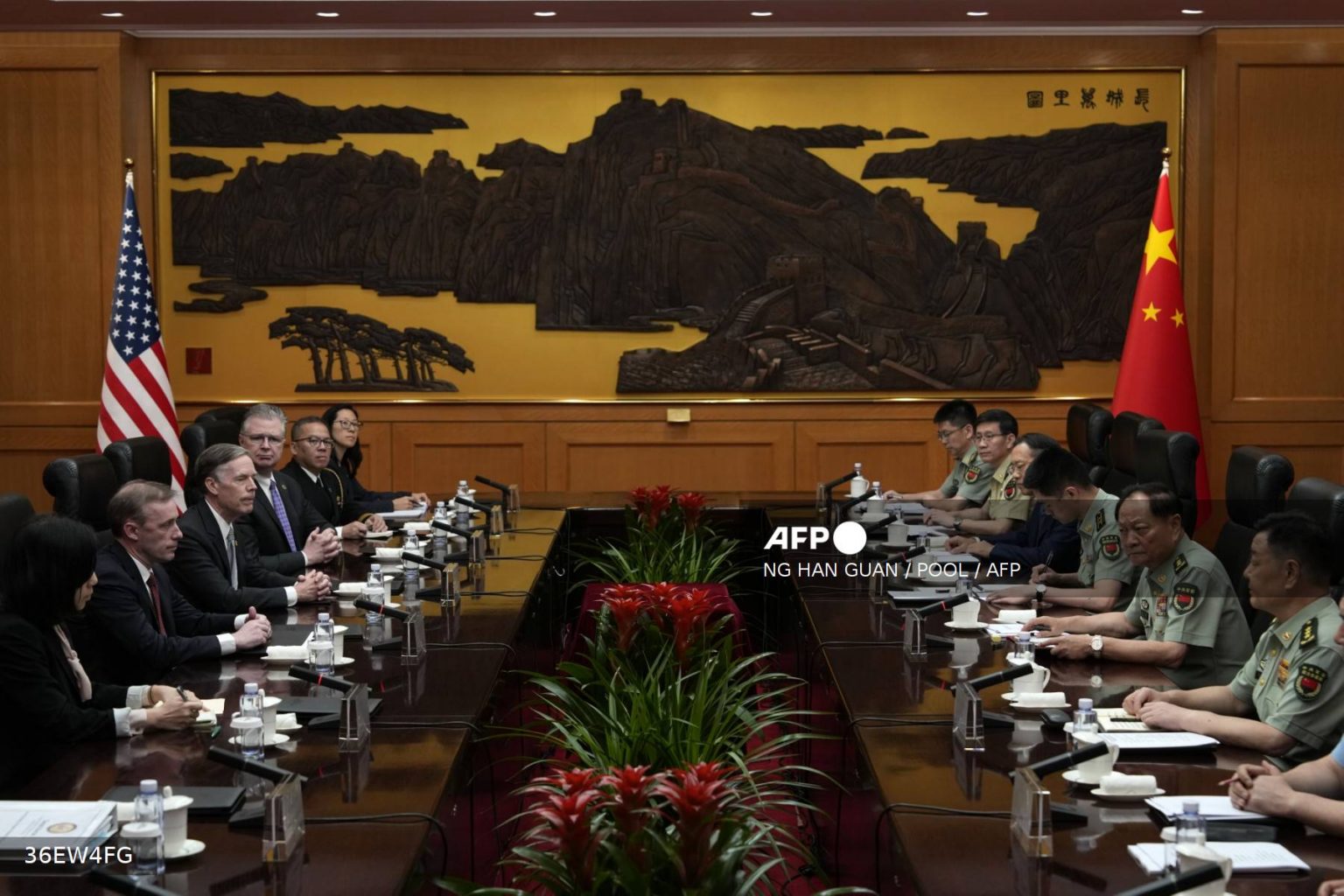

Beijing, China — In a rare and high-stakes meeting, a senior Chinese military official issued a stern warning to the United States, urging it to cease “collusion” with Taiwan, while White House National Security Advisor Jake Sullivan emphasized the need for stability in the Taiwan Strait. The exchange took place on Thursday during Sullivan’s visit to Beijing, marking the first such visit by a US national security advisor since 2016.
Sullivan’s visit comes amid escalating tensions between China and US allies Japan and the Philippines, as well as ongoing disputes over security and territorial integrity in the Indo-Pacific region. Over three days, Sullivan held talks with key Chinese officials, including Foreign Minister Wang Yi, focusing on critical issues that have strained US-China relations.
On Thursday morning, Sullivan met with Zhang Youxia, a senior Chinese military chief, at the headquarters of the Central Military Commission in Beijing. The meeting was characterized by candid exchanges, reflecting the deep-seated differences between the two nations.
“We rarely have the opportunity to have this kind of exchange,” Sullivan remarked at the start of the meeting, signaling the significance of the dialogue between the two powers. Both sides agreed to arrange a call between their respective theatre commanders in the near future, a move aimed at reducing the risk of military miscalculation.
During the discussions, Sullivan underscored the importance of “freedom of navigation” in the South China Sea, a region where tensions have flared between Beijing and Manila in recent months. He also highlighted the need for “stability” in the Taiwan Strait, a key flashpoint in US-China relations.
Zhang, in response, reiterated China’s firm stance on Taiwan, describing it as the “first red line that cannot be crossed” in China-US relations. He emphasized that “Taiwan independence” and peace in the Taiwan Strait are fundamentally incompatible, demanding that the US halt its military support for Taiwan and cease spreading “false narratives” related to the island.
The talks also touched on broader regional and global security concerns. Sullivan expressed US concerns about China’s alleged support for Russia’s defense industrial base, a claim Beijing has consistently denied. Additionally, Sullivan raised issues related to cyber security, the ongoing conflict in Gaza, and efforts to reach a ceasefire and hostage deal in the region.
On Wednesday, Sullivan’s meeting with Wang Yi focused on the upcoming dialogue between US President Joe Biden and Chinese leader Xi Jinping, as well as China’s increasingly assertive behavior in disputed maritime regions. Sullivan reaffirmed the United States’ commitment to defending its Indo-Pacific allies, particularly in light of China’s actions against Philippine maritime operations in the South China Sea.
Chinese state media reported that Wang Yi issued a pointed warning to Washington, cautioning the US against using bilateral treaties to undermine China’s sovereignty and territorial integrity. He specifically criticized US support for the Philippines’ actions in the disputed waters.
This week’s talks mark the latest in a series of engagements between Sullivan and Wang, who have met multiple times over the past year and a half in various locations, including Washington, Vienna, and alongside their respective leaders in California in November 2023. Despite these efforts, the issue of Taiwan continues to loom large, with China maintaining a hardline stance since the inauguration of Taiwanese President Lai Ching-te, whose party advocates for Taiwan’s separate identity.
As Sullivan’s visit concludes, the world watches closely, aware that the outcomes of these discussions could shape the future of US-China relations and stability in the Indo-Pacific region.