
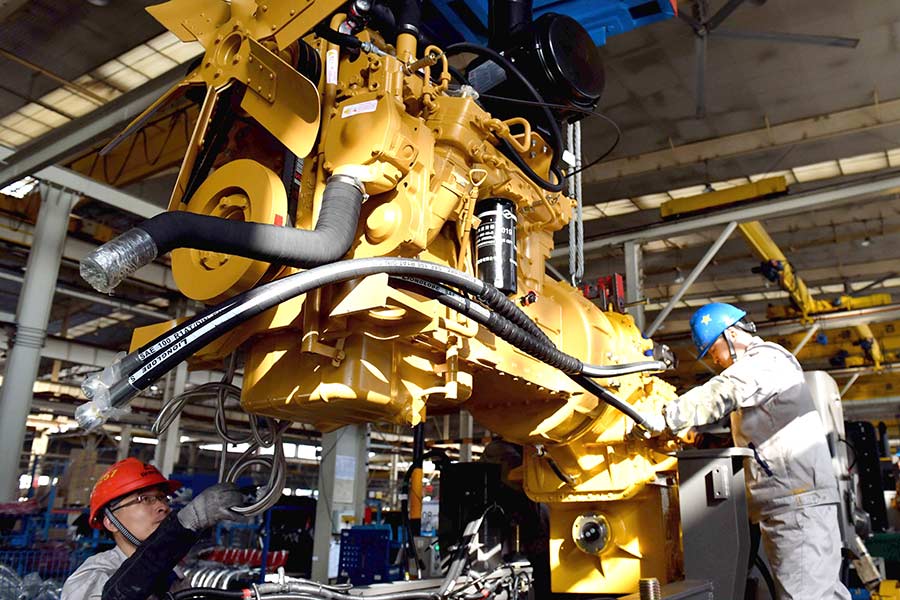

China’s manufacturing sector demonstrated signs of a sustained recovery in November, with recent government stimulus measures boosting consumer and investor confidence, according to analysts. The recovery reflects China’s economic resilience, even in the face of ongoing domestic and global challenges.
The National Bureau of Statistics (NBS) reported that China’s official purchasing managers’ index (PMI) for manufacturing rose to 50.3 in November, up from 50.1 in October. This marks the second consecutive month above the critical 50-point threshold, which separates expansion from contraction, and is the highest PMI in seven months.
Zhao Qinghe, a statistician at NBS, attributed the steady improvement in economic activity to the effects of the government’s incremental policy package and ongoing fiscal stimulus, which have gradually boosted market confidence.
Manufacturers’ optimism was reflected in the data, with the subindex for manufacturers’ expectations for production and operations rising to 54.7 in November, compared to 54 in October. The subindex for production also saw an increase, reaching 52.4 in November, up from 52 in October. Additionally, the gauge for new orders improved to 50.8 in November, from 50 in October.
Analysts like Wu Chaoming from the Chasing International Economic Institute noted that the recovery in demand and supply was driven by a combination of stimulus policies and more workdays in November. As a result, factory activity is expected to continue expanding into December.
Despite the positive manufacturing PMI, other indicators revealed mixed results. China’s non-manufacturing PMI, which includes data from services and construction, dropped slightly from 50.2 in October to 50 in November, indicating weaker activity in those sectors. The country’s composite PMI, which includes both manufacturing and non-manufacturing data, remained unchanged at 50.8 in November.
Experts, including Wang Qing from Golden Credit Rating International, suggested that the Chinese economy is poised for a rebound in the fourth quarter, with a projected GDP growth of around 5.3% year-on-year. This would mark a notable improvement from the 4.6% growth in the third quarter and bring the country closer to its annual GDP growth target of approximately 5%.
However, Wang highlighted that the recovery remains moderate and that more stimulus may be necessary to boost market demand further, particularly in the real estate sector. He added that future improvements in the external trade environment in 2025 could play a crucial role in sustaining growth.
Robin Xing, chief China economist at Morgan Stanley, pointed out that the recent shift in government policies shows a strong commitment to boosting economic growth, stabilizing expectations, and fostering confidence.