
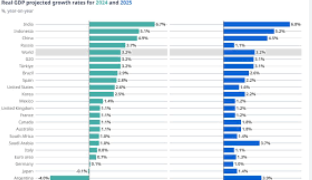

PARIS – The global economy is expected to grow by 3.2% in 2024, with further growth of 3.3% projected for both 2025 and 2026, according to the latest economic outlook released by the Organization for Economic Cooperation and Development (OECD) on Wednesday.
While the global economy shows resilience, the OECD report highlights significant regional disparities and ongoing challenges. Emerging Asia continues to drive global growth, while the U.S. economy is forecast to expand by 2.8% in 2025 before slowing to 2.4% in 2026. In contrast, the euro area is expected to grow more modestly, with GDP increases of 1.3% in 2025 and 1.5% in 2026, supported by improving household incomes, tight labor markets, and reductions in policy interest rates.
The OECD also warned that higher uncertainty and rising trade-restrictive measures could raise costs, deter investment, weaken innovation, and ultimately hinder growth.
Regarding inflation, the OECD noted that while inflation has returned to target levels in several advanced and emerging-market economies, pressures persist in service sectors. In OECD member countries, inflation is projected to decline from 5.4% in 2024 to 3.8% in 2025, and further to 3.0% in 2026, helped by ongoing restrictive monetary policies.
As a result, central banks are expected to lower interest rates further, with real interest rates potentially reaching neutral levels by 2026.
Despite these positive outlooks, OECD Secretary-General Mathias Cormann cautioned that significant challenges remain, urging nations to reduce inflation durably, address rising fiscal pressures, and tackle labor shortages to boost long-term growth.