
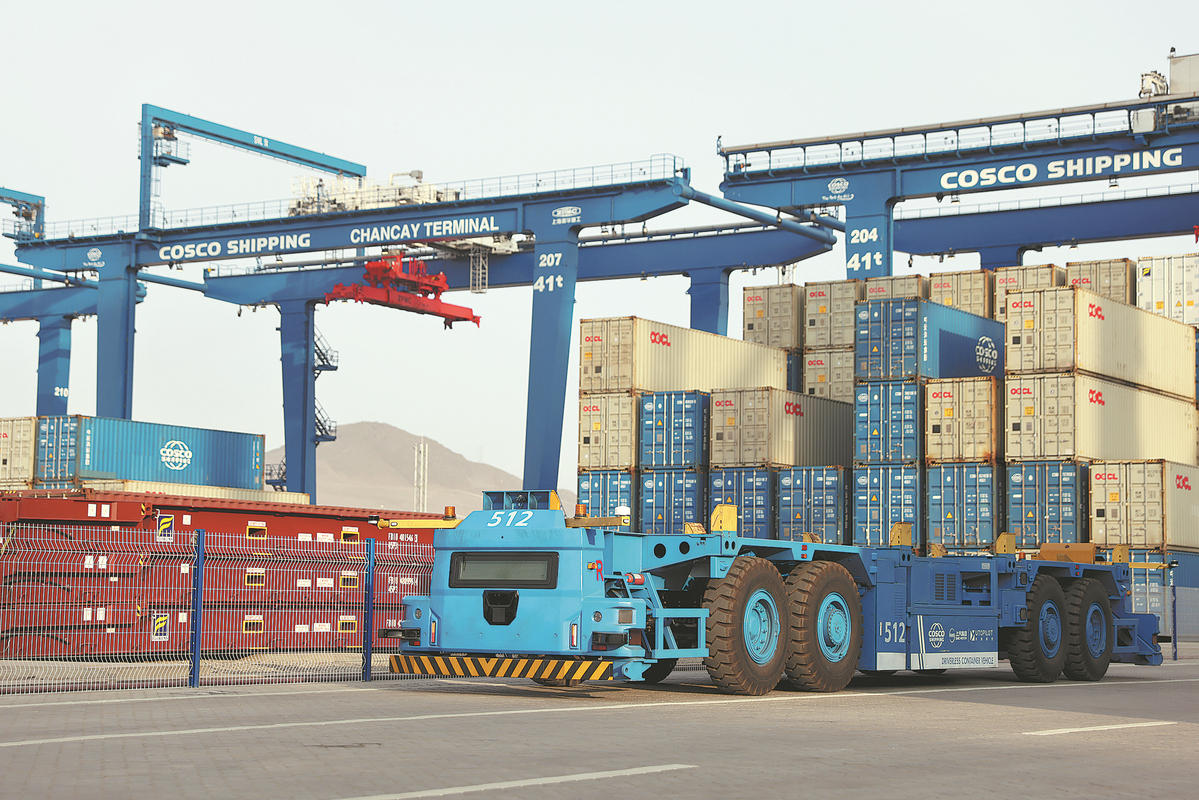

China and Peru, though separated by the vast Pacific Ocean, are increasingly linked through economic cooperation, exemplified by the Chancay Port project in Peru. This deepwater port, a pivotal element of the Belt and Road Initiative (BRI), is set to transform Peru’s trading competitiveness and reshape Latin America’s economic integration with global markets, particularly with Asia.
Strategic Location and Infrastructure
Chancay Port is located approximately 60 kilometers north of Lima, Peru’s capital, and represents a collaborative effort between China’s COSCO Shipping and Peru’s Volcan Compania Minera SAA. The port’s construction began in 2021, with operations officially commencing on November 15. It features four dock berths with a depth of 17.8 meters, making it capable of accommodating mega container ships with capacities of up to 18,000 TEUs (twenty-foot equivalent units). This infrastructure significantly enhances Peru’s ability to handle large-scale international trade.
Overcoming Logistic Barriers
Prior to Chancay Port, Peru lacked a deepwater port capable of handling large container ships. Consequently, cargo shipments from China to Peru had to be transshipped through intermediate hubs, such as Mexico or Panama, which added considerable time and cost to the supply chain. The new port directly addresses this issue, reducing the shipping time from Peru to China to just 23 days, thus slashing logistics costs by at least 20 percent, according to Zhou Mi, a senior researcher at the Chinese Academy of International Trade and Economic Cooperation.
Economic Impact on Peru
Chancay Port’s opening has already begun to generate substantial economic benefits for Peru. According to the Central Reserve Bank of Peru, the port’s first phase is expected to contribute 0.3 percent to the country’s GDP. Once the entire infrastructure is completed, this figure could rise to 0.9 percent of Peru’s total economic output.
Additionally, the port has created thousands of new jobs. To date, the port’s construction has generated approximately 1,300 direct jobs, with another 8,000 indirect jobs supported through supply chains and ancillary industries. This job creation will have a far-reaching impact on local communities, further strengthening the social fabric of the region.
Enhancing Trade and Connectivity Across Latin America
Beyond its direct economic impact on Peru, Chancay Port is expected to significantly enhance trade flows across the Latin American region. According to Liang Haiming, the dean of the Belt and Road Research Institute at Hainan University, the direct maritime connections between Asia and Latin America will reduce the transit time for cargo between the two regions from 35 days to just 25 days. This acceleration in shipping times opens up new trade and investment opportunities for Latin American countries, making the region more competitive and better integrated into global trade networks.
This development is part of China’s broader vision under the Belt and Road Initiative, which seeks to foster shared prosperity by strengthening economic and infrastructure ties across the Global South. By improving trade and logistics capabilities, China aims to support Latin American economies in diversifying their economic relationships and reducing dependency on traditional economic powers.
A Vision for Shared Prosperity
The BRI has already seen 22 Latin American and Caribbean nations sign cooperation memoranda, and the Chancay Port project serves as a powerful symbol of China’s growing influence in the region. This cooperation provides Latin American countries with a pathway to reduce reliance on traditional trading partners and explore alternative, more diversified economic models.
For Peru and the wider Latin American region, the Chancay Port marks a new era of connectivity and economic growth. By facilitating smoother, faster trade links between Asia and Latin America, the port will play a crucial role in shaping the region’s future economic landscape and cementing its position as a critical player in the global market.