
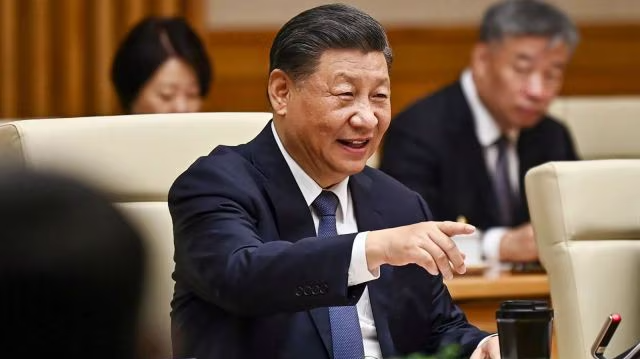

In a bold move aimed at strengthening China’s global trade position, President Xi Jinping has signed nearly 40 economic agreements with Vietnam during his official visit to Hanoi. These agreements, which span a wide array of sectors including infrastructure, technology, and energy, are seen as a strategic effort to mitigate the economic impact of U.S. tariffs on Chinese exports.
The signing ceremony, which took place on April 13, 2025, marks a significant step in China’s ongoing effort to diversify its trade relationships and reduce its dependency on the United States amid an ongoing trade dispute. President Xi’s visit to Vietnam, one of China’s key economic partners in Southeast Asia, highlights the growing alignment between the two nations as they work to bolster their economic ties and counterbalance U.S. influence in the region.
Xi, who was welcomed by Vietnamese President Vo Van Thuong, praised the growing economic and political partnership between China and Vietnam. He emphasized that the agreements would not only benefit the two countries but also contribute to broader regional stability and prosperity.
“This is a new chapter in the China-Vietnam partnership. Together, we are building a resilient economic future that is not reliant on external pressures, such as tariffs imposed by the United States,” Xi said during the press conference following the agreement signings.
The agreements, which are valued at billions of dollars, cover various initiatives aimed at strengthening trade, investment, and technological cooperation. Among the highlights are joint ventures in renewable energy projects, high-speed rail infrastructure development, and the expansion of digital trade platforms. Additionally, both nations agreed to increase the flow of goods and services, bypassing the economic barriers created by U.S. tariffs on Chinese products.
Vietnam’s government has been keen to strengthen its ties with China, given the increasing challenges posed by the U.S.-China trade war. With the United States imposing tariffs on Chinese goods in recent years, Vietnam has positioned itself as a favorable alternative for manufacturers looking to avoid the heavy penalties associated with Chinese exports.
The trade agreements come at a time of rising tensions between China and the United States, with the latter’s tariffs significantly impacting China’s manufacturing sector. The Chinese government has been actively pursuing new trade alliances, particularly with nations in Asia, Africa, and Europe, to mitigate the fallout from U.S. economic policies.
The U.S. has yet to respond officially to the developments in Hanoi, but analysts believe that Washington will closely monitor China’s growing influence in Southeast Asia. The U.S. is already grappling with the economic consequences of the trade war, and China’s expanded partnerships in the region could further shift the balance of power in global trade.
China’s broader efforts to counter U.S. tariffs are also evident in its increased trade partnerships with countries such as Russia, Brazil, and India. By diversifying its trade relations, China hopes to cushion the impact of U.S. sanctions and maintain its economic growth trajectory despite the ongoing trade dispute.
Experts suggest that Xi Jinping’s successful trip to Hanoi and the new agreements represent a significant step toward China’s broader vision of economic and geopolitical influence in the 21st century. The move signals that China is not only resilient in the face of economic pressures but also willing to forge new alliances that position it as a central player in global trade.
source: asianews.it