
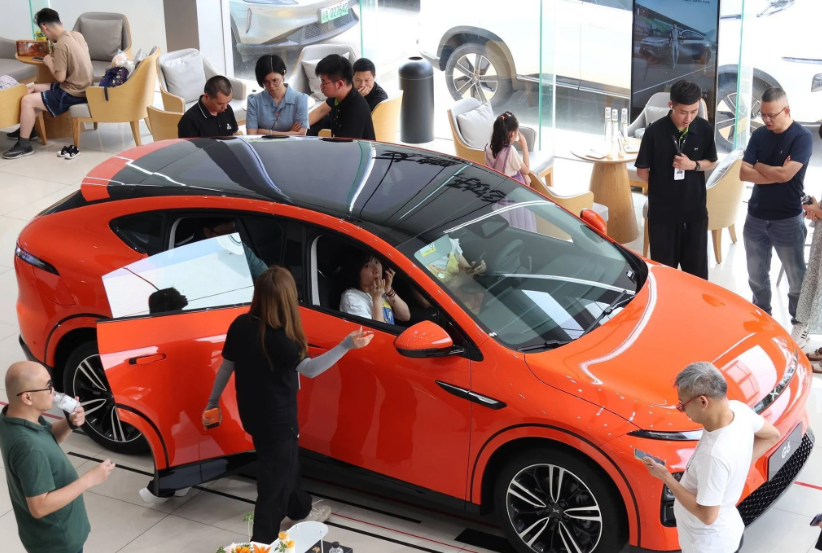

China’s booming electric vehicle (EV) sector has shown its sharpest slowdown in a year and a half, raising questions about whether the industry can sustain the blistering pace that made the country the world’s largest market for new-energy cars.
Industry data released this week shows that sales of battery-powered EVs and plug-in hybrids grew at their slowest rate in 18 months, despite government subsidies and aggressive price competition led by major manufacturers such as BYD and Tesla.
According to the China Passenger Car Association (CPCA), year-on-year sales in August rose by just under 30% a steep decline from the double-digit surges seen throughout much of 2023 and early 2024. Analysts attribute the cooling trend to weakening consumer demand, rising borrowing costs, and signs of saturation in urban markets where EV adoption has already taken off.
“The market is entering a new phase,” said Chen Jia, an independent auto industry analyst in Beijing.
“The era of explosive growth may be over, and companies will now face the challenge of competing on technology, after-sales service, and global expansion rather than relying on domestic demand alone.”
China’s EV makers have dominated the global stage, accounting for more than half of worldwide electric vehicle sales last year. But intensifying competition and price wars have eaten into profits. Several smaller startups are struggling to survive as giants like BYD, Geely, and SAIC consolidate their hold.
Meanwhile, international pressure is mounting. The European Union has launched an investigation into whether Chinese EVs benefit from unfair state subsidies, raising the prospect of tariffs that could affect overseas expansion plans.
Domestically, the government has sought to balance encouragement of green mobility with concerns about overcapacity and mounting debt among manufacturers. While subsidies remain, Beijing has signaled it wants the industry to “stand on its own feet” rather than rely indefinitely on state support.
Consumers, too, are becoming more selective. Surveys show that while interest in EVs remains high, concerns about charging infrastructure, battery longevity, and resale value are making buyers more cautious.
Despite the slowdown, experts stress that China’s EV market is far from stalling. The country still leads the global transition to clean mobility, and policymakers are expected to introduce fresh incentives in rural areas and second-tier cities where adoption lags behind.
For automakers, however, the message is clear: the easy growth phase is over, and survival will depend on innovation and efficiency in an increasingly crowded marketplace.