
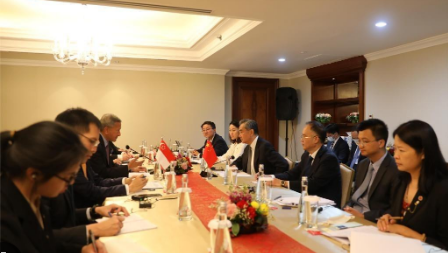

Chinese diplomat Wang Yi emphasized the importance of cooperation, peace and stability, ASEAN centrality, and development in his remarks during the ASEAN foreign ministers’ meetings and bilateral meetings held in Jakarta on Thursday and Friday.
Amid increasing major-power competition in Southeast Asia, China delivered a strong message to promote regional solidarity and enhanced cooperation. Analysts believe that China aims to counter external attempts to create trouble and discord among regional countries.
Wang Yi, the director of the Office of the Foreign Affairs Commission of the Communist Party of China Central Committee, called for strengthened cooperation between ASEAN, China, Japan, and South Korea at the ASEAN Plus Three (APT) Foreign Ministers’ Meeting. All parties expressed support for an open and inclusive ASEAN-centered regional cooperation framework, multilateralism, and the maintenance of regional peace, stability, and prosperity.
During the China-ASEAN 10+1 meeting, Wang Yi revealed progress in negotiations for version 3.0 of a free trade agreement (FTA) and highlighted significant projects under the joint construction of the Belt and Road Initiative.
The meeting resulted in the passing of a joint statement commemorating the 20th anniversary of China’s accession to the Treaty of Amity and Cooperation in Southeast Asia. It also established guidelines to expedite the development of a Code of Conduct (COC) for the South China Sea, as reported by the Chinese Ministry of Foreign Affairs during a routine press briefing on Friday.
In a meeting with Singaporean Foreign Minister Vivian Balakrishnan, Wang Yi stressed the importance of China and ASEAN jointly safeguarding the global free trade system and upholding ASEAN centrality.
Chinese experts highlighted that China, as a major regional power, has consistently shouldered the responsibility of maximizing common interests, managing differences through negotiation, and working towards shared development and prosperity in the region.
Regarding recent incidents in the South China Sea, experts emphasized the need for “consultations and negotiations by sovereign states directly concerned” and cautioned against internationalizing or complicating the issue.
During a meeting with US Secretary of State Antony Blinken on the sidelines of the ASEAN meetings, Wang Yi emphasized the importance of respecting the efforts of regional countries, supporting ASEAN centrality, and avoiding the inclusion of disputes and complex factors in regional cooperation.
Analysts noted that China’s relationship with ASEAN focuses on shared benefits and is not exclusive. China welcomes ASEAN member states to engage in cooperation with other countries, as the region should serve as an engine for global growth rather than a battleground for power competition.
Experts pointed out that the US’ engagement with ASEAN member states is driven by its rivalry with China and aims to mobilize the bloc to advance its Indo-Pacific Strategy. This engagement is perceived as centered on containing China, including efforts toward “decoupling” and a stronger military presence. Analysts cited the Indo-Pacific Economic Framework, military architectures like the Quad and AUKUS, frequent drills in the South China Sea, and US access to four Philippine military bases in April.
Analysts stressed that for emerging economies in the region, aligning with either China or the US does not serve their interests or promote sustainable development. ASEAN member states are encouraged to focus on achieving sustainable security and prosperity, avoiding actions that generate division and chaos.