
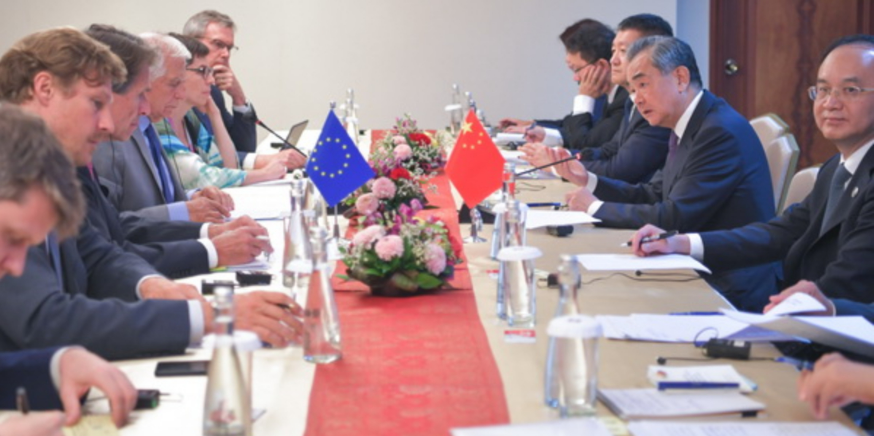

European Union (EU) High Representative for Foreign Affairs and Security Policy, Josep Borrell, met with Wang Yi, director of the Office of the Central Commission for Foreign Affairs, to discuss China-EU relations and key issues. Borrell emphasized that the EU views China as an important partner and does not support confrontation or parallel systems. He clarified that the EU’s “de-risking” initiatives are not targeted at China and the EU has no intention of hindering China’s development.
Chinese analysts welcomed Borrell’s statements, interpreting them as representing the official stance of the EU and refuting negative opinions about China-EU relations. They viewed the remarks as indicative of a positive momentum in bilateral ties, resulting from increased communication and exchanges between the two sides.
During the meeting, Wang Yi highlighted that China and the EU share common interests as advocates of multilateralism, multipolarity, and a democratic international system centered around the United Nations. He urged the EU to clarify its strategic partnership positioning and promote the advancement of China-EU relations based on existing foundations.
Borrell reaffirmed that China is a crucial partner for the EU, expressing the EU’s willingness to maintain strong engagement and develop a constructive, stable, and long-term relationship with China. He emphasized the EU’s commitment to the one-China policy and its rejection of “Taiwan independence.” Borrell recognized China’s global role and expressed a desire to explore ways to strengthen policy synergy and practical cooperation between the EU and China.
In response, Wang stressed China’s commitment to building an open economy and sharing market opportunities with the world. He expressed support for the EU’s pursuit of strategic independence and independent judgments, suggesting cooperation between China’s Belt and Road Initiative (BRI) and the EU’s Global Gateway strategy.
Chinese analysts cautioned that while there are positive trends in China-EU relations, disagreements and divisions among EU member states remain, and some European countries may still