
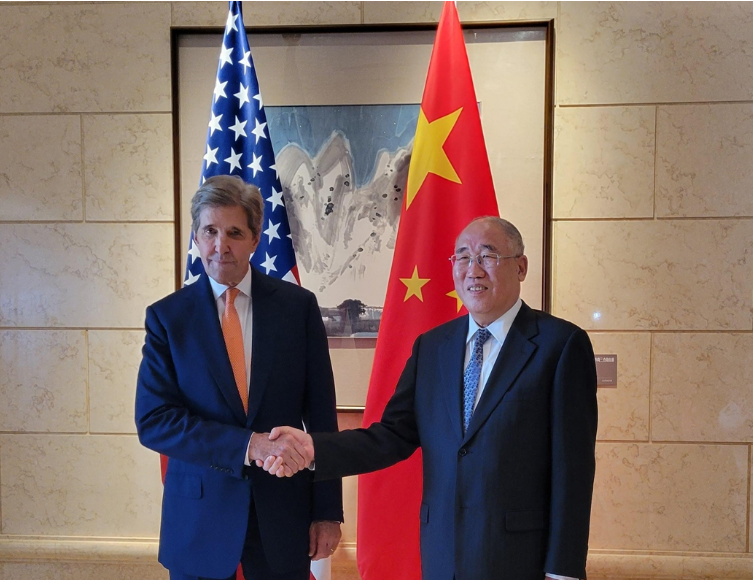

China’s special envoy for climate change, Xie Zhenhua, and US climate envoy, John Kerry, engaged in four hours of discussions on Monday, signaling renewed efforts to revive climate cooperation between the two countries. The talks are seen as a positive signal for bilateral relations, which are currently at a historical low.
The agenda for the meeting included discussions on reducing methane emissions and coal use. Experts emphasize that climate change cooperation is not isolated from the complexities of “rivalry and cooperation” and “divergences and shared responsibilities” characterizing China-US relations.
While the US claims to seek climate cooperation, it has simultaneously maintained pressure on Beijing in areas such as trade and technology, creating obstacles for joint efforts in combating climate change. The US’s inconsistent climate policies under partisan politics have been seen as a hindrance to effective collaboration with China.
China seeks substantial dialogue during this week of talks, recognizing that exchanges on climate and the green transition could contribute to improving bilateral relations. Kerry expressed his hope that China and the US would take significant steps to demonstrate their commitment to addressing the common threat of climate change.
When asked about the details of the meeting, Chinese Foreign Ministry spokesperson Mao Ning emphasized that climate change is a global issue, and China is committed to implementing the spirit of previous meetings between the two heads of state. China aims to engage in in-depth discussions with the US on climate change and work together to address the issue.
The US National Security Advisor, Jake Sullivan, stated that Kerry would urge Beijing not to hide behind its “developing nation” status to impede emission reduction efforts. However, some experts caution that the US may exploit climate change as a tool to contain China, pressuring it to assume additional responsibilities and set ambitious emission reduction targets that exceed its capabilities.
Key issues on the agenda include China’s coal use, methane emissions, the global carbon compensation market, and meeting the needs of developing countries. The US is expected to demand that China establish an international fund and compensation mechanism for countries that fail to meet emissions standards. Experts acknowledge that climate change cooperation, while crucial, is also subject to the complexities and rivalries inherent in major-power dynamics.
Despite challenges, climate change cooperation remains a potential strategic pillar for stabilizing China-US relations. Previous agreements on climate change have been achieved despite shifts in US attitudes and policies. However, the inconsistent and uncertain climate policies resulting from domestic political dynamics pose a significant obstacle to sustained collaboration.
China has made ambitious pledges to reach carbon emissions peak by 2030 and achieve carbon neutrality by 2060. The US’s claims about China’s status as a developing country are viewed as attempts to limit China’s opportunities for development. This politicization of climate issues underscores the intertwined nature of climate cooperation and geopolitical rivalries.
As discussions progress, stakeholders must acknowledge the complexities and tensions inherent in climate change cooperation while striving to find common ground and shared interests amidst the broader China-US competition.