

Amidst renewed tensions between China and Japan, China has strongly urged Japan to reflect genuinely on its historical actions and completely distance itself from militarism through concrete measures. This call comes in response to Japanese Prime Minister Fumio Kishida’s recent ritual offering to the controversial Yasukuni Shrine, which honors convicted Class-A Japanese war criminals from World War II.
As China commemorates the 78th anniversary of Japan’s surrender in World War II, analysts have raised concerns about the resurgence of militarism in Japan. They point to the actions of right-wing forces within Japan that seem to downplay the country’s wartime crimes and challenge the post-war anti-fascist achievements. Under the security umbrella provided by the United States, Japan’s military ambitions have raised alarms among regional nations.
Kishida, as leader of Japan’s ruling Liberal Democratic Party (LDP), offered a symbolic gesture at the Yasukuni Shrine. Additionally, members of Kishida’s cabinet paid homage at the shrine, igniting further controversy. The shrine, known for its diplomatic sensitivity, has long been a point of contention between Japan and its neighboring countries.
Chinese Foreign Ministry Spokesperson Wang Wenbin expressed deep concern over Japan’s actions at the Yasukuni Shrine, emphasizing that this reflects Japan’s distorted historical perspective. Wang underscored the importance of Japan acknowledging and reflecting on its wartime aggression as a prerequisite for fostering normal relations with its Asian neighbors.
China’s Foreign Ministry spokesperson emphasized, “China urges the Japanese side to earnestly learn lessons from history, stick to the path of peaceful development, take concrete actions to completely break with militarism, and avoid further breaking trust with its Asian neighbors and the international community.”
A representative from the Chinese Embassy in Japan described the Yasukuni Shrine as a symbol of Japanese militarism’s aggressive past. The ongoing controversy surrounding the shrine underscores the need for the Japanese government to properly address its history of aggression.
Notably, on the 78th anniversary of Japan’s World War II defeat, Kishida’s speech omitted any mention of Japan’s wartime actions in Asia or the suffering of its victims in the region.
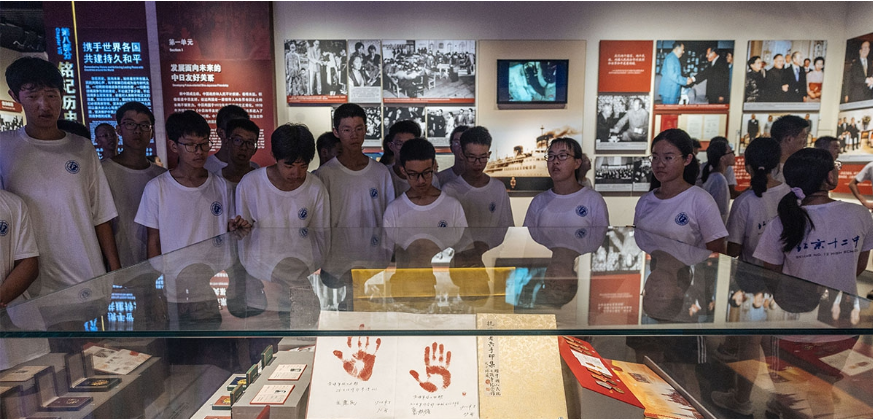
In response to Japan’s actions, China conducted a nationwide commemoration of the anniversary, with events honoring the victims of Japan’s wartime aggression. Various memorials and exhibitions showcased historical artifacts and evidence of Japan’s brutal invasion, highlighting the immense human cost.
Amid concerns of Japan’s military buildup and resurgent militarism, experts have cautioned against undermining the post-war international order. Japan’s recent amendments to its national security strategy documents and its shift toward countering strategic challenges, particularly from China, have raised concerns among its Asian neighbors.
The regional dynamics have led South Korea to take a nuanced stance on Japan’s actions, with a focus on deeper security cooperation with both Japan and the United States to address North Korean nuclear threats. However, this approach has sparked criticism, as some experts argue it could overlook historical suffering.
As tensions persist and historical sensitivities remain a point of contention, the region watches closely for Japan’s response and its potential impact on regional stability and security.