
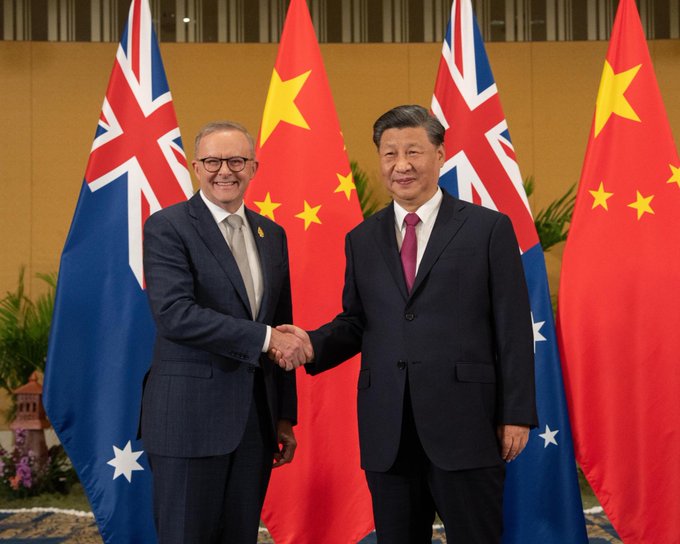

Anthony Albanese’s recent visit to China marked a historic moment as it was the first visit by an Australian Prime Minister in seven years. While it garnered significant attention in Australian media, the visit holds a different level of significance for Beijing.
The visit by Albanese to China was seen as an opportunity to address some of the issues that had strained relations between the two countries. Beijing viewed the visit as a means to clear one of the many problems it currently faces. According to Ryan Neelam, the director of the Lowy Institute’s public opinion and foreign policy program, “Albanese’s visit was on China’s timing but not its preferred terms. It was important to have one less problem in Australia, amid a whole host of problems.”
Australia-China relations have been tense for several years, and this visit aimed to ease some of the friction. However, it’s crucial to understand that China is dealing with a multitude of domestic and international challenges. Relations with the United States are at a historic low, and China is becoming increasingly isolated from Western nations and its allies due to regional aggression. It also faces economic and unemployment challenges, political scandals, and complex alliances, such as the one with Russia.
Simultaneously, China is positioning itself as a responsible superpower and an alternative to the United States. President Xi Jinping is actively pursuing global influence, presenting China as a leader of the global south and a counterbalance to Western powers.
From Beijing’s perspective, key points of tension with Australia include the ban on Huawei technology from Australia’s 5G network, suspicions about Chinese investments in critical infrastructure, Australia’s call for a COVID-19 origins inquiry, criticism of China’s regional expansionism and human rights violations, and what Beijing perceives as Australia’s unwavering support for the United States.
China has exercised “patience and restraint” in response to Australia’s actions that it considered crossing “beyond acceptable lines.” It had previously imposed trade tariffs and restrictions on Australian goods, costing the Australian economy billions of dollars. China attributed the issues to former Australian Prime Ministers, Scott Morrison and Malcolm Turnbull.
Although the change in government in Australia provided an opportunity for a fresh start, Australian officials have made it clear that the relationship will not return to its previous state, and the country’s foreign policy remains largely consistent.
Ahead of Albanese’s visit, some trade restrictions were eased or lifted as a sign of goodwill. However, it’s important to assess whether this signifies a genuine change in China’s approach toward Australia or is part of a longer-term strategy to reshape the Australia-China relationship.
While some areas may disappoint China, such as Australia’s support for China’s admission to the Comprehensive and Progressive Agreement for Trans-Pacific Partnership (CPTPP) and its alliance with the United States, Beijing is seeking to maximize the benefits of reducing tensions and adopting a less confrontational tone.
China’s coverage of the visit has been overwhelmingly positive, emphasizing “win-win cooperation” and the return of Australia to the “right path” to improve bilateral relations. Beijing is skilled at shaping narratives and is focused on domestic audiences, framing the visit as a successful outcome of its pressure on the Albanese government to bring Australia back to the table and align with China’s interests.
In summary, Albanese’s visit to China represents a step toward repairing strained relations, but it’s essential to keep in mind the broader context of China’s evolving global position and its domestic challenges. The long-term impact of the visit on Australia-China relations remains to be seen.