

In a notable development, senior military officials from China and the US engaged in a virtual meeting on Thursday night, marking the first high-level military dialogue in over a year. Both sides highlighted the significance of exchanges and dialogue during the video call, but the Chinese delegation emphasized that healthy, stable, and sustainable military ties require the US to “genuinely respect China’s core interests and major concerns.”
The video teleconference featured Liu Zhenli, a Central Military Commission member and the chief of the CMC’s Joint Staff Department, and General Charles Q. Brown, Chairman of the Joint Chiefs of Staff of the US. Liu stressed that the foundation for fostering robust military relations is based on the US having a correct perception of China and genuinely respecting its core interests.
The timing of the dialogue coincides with the US approving arms sales to Taiwan and encouraging the Philippines to challenge China’s sovereignty over the Ren’ai Reef in the South China Sea. Liu emphasized that the Taiwan issue is China’s internal affair, and external interference is unwarranted. He urged the US to respect China’s territorial sovereignty and maritime rights in the South China Sea, urging prudent actions for regional peace.
While the dialogue covered responsible competition management and open communication, analysts see this as a positive start for resuming military channels between the two nations. Expectations include the resumption of meetings between defense authorities and telephone conversations between theater commanders.
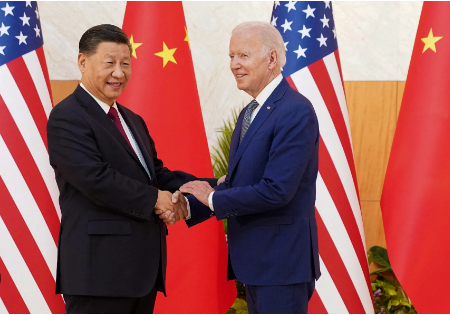
The virtual meeting signals a mutual willingness to stabilize ties and manage risks, emphasizing the avoidance of direct conflict. Despite increasing dialogues and easing tensions since July, uncertainties persist, especially regarding the US strategic competition stance and provocations against China. The Taiwan question remains a significant variable in the normalization of China-US military relations. The meeting follows the Xi-Biden summit in November, where both leaders agreed to resume military communication channels.
While experts acknowledge positive developments, they caution that destabilizing factors persist, urging the US to abandon a hegemonic mentality and ensure consistency between words and actions. The resumption of military exchanges should not be leveraged as a tool to pressure China. The communication channels remain fragile, with uncertainties surrounding regional elections in Taiwan, US congressional dynamics, and disputes in the South China Sea posing ongoing tests for the relationship.
China urges the US to implement the consensus reached during the Xi-Biden summit and engage in exchanges and cooperation based on equality and respect. The resumption of high-level dialogue presents an opportunity for constructive engagement, provided the US takes concrete actions to safeguard stable China-US relations and regional peace.