
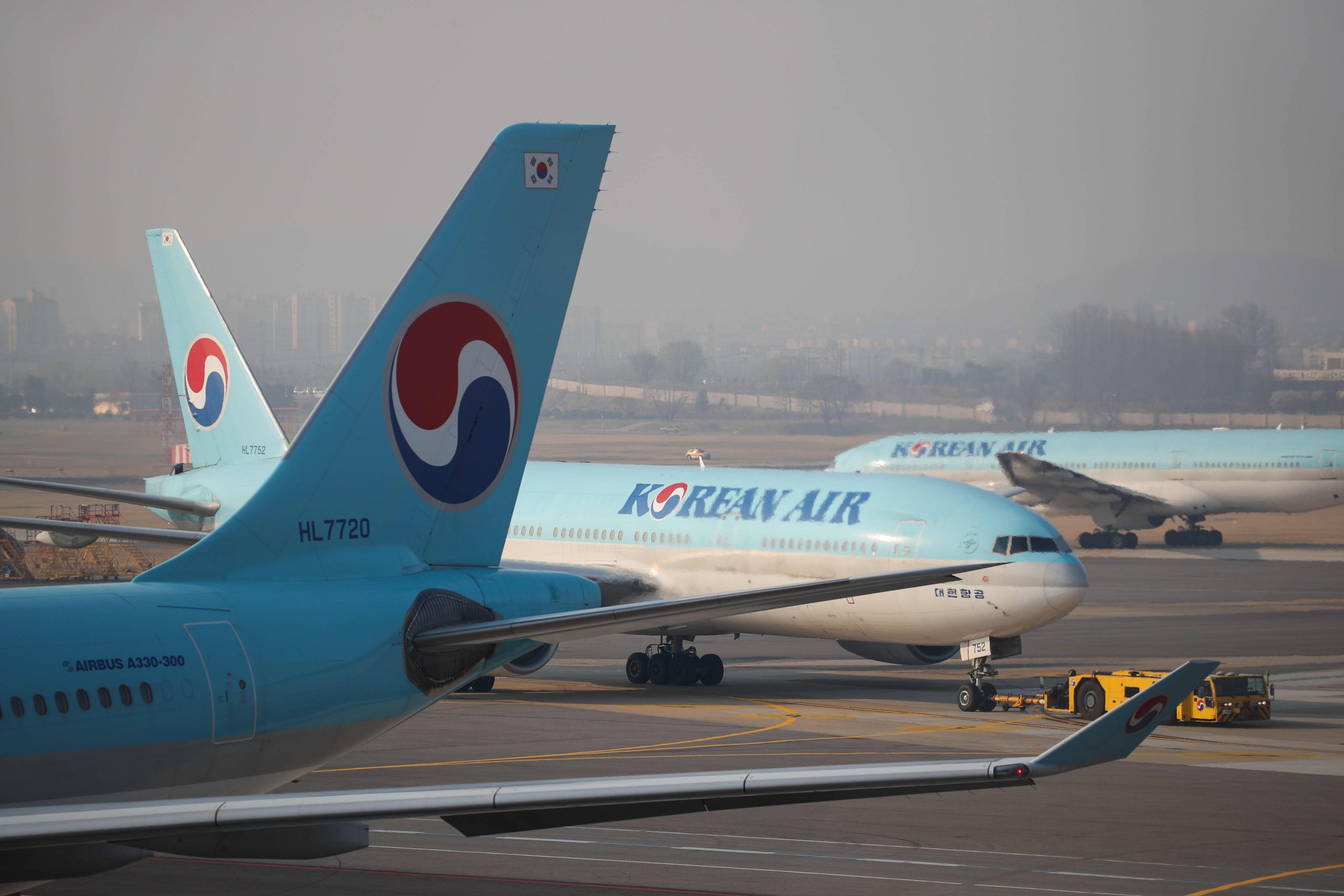

Strained relations and low passenger numbers cited as reasons for route suspensions
South Korean airlines, including the country’s largest carrier Korean Air, have reportedly announced the suspension of flight routes to destinations in China. The move comes in response to a significant drop in demand, attributed to strained relations between China and South Korea, according to Korean media.
Chinese observers view the adjustments as market-driven, reflecting the low confidence of South Korean airlines in the short-term prospects for increased passenger loads. This lack of confidence stems from the current administration of President Yoon Suk-yeol, which has yet to demonstrate the resolution and willingness to improve ties with China, as cited by Chinese observers.
Data from the Korea JoongAng Daily reveals a sharp decline in passengers flying from South Korea to China. From April to May, the total number of passengers amounted to 402,410, representing a 73.7 percent drop compared to the corresponding period in 2019, prior to the COVID-19 pandemic outbreak.
Korean Air, in response to the declining demand, announced the suspension of its daily flights between Seoul’s Gimbo International Airport (GMP) and Beijing from August until October 28. Additionally, flights between GMP and Gaoqi International Airport in Xiamen, Fujian Province, will be suspended from August 8 to October 28, as reported by South Korea’s Yonhap News Agency. An insider from Korean Air confirmed the flight suspensions, attributing them to the lack of passenger demand and low load factors on these routes.
Similarly, Asiana Airlines, South Korea’s second-largest carrier, will suspend its daily route from GMP to Beijing airports starting from July 6. It had already halted the route between Incheon and Xi’an, the capital of Shaanxi Province, since June 20. In addition, a route from Incheon to Shenzhen in Guangdong Province will be suspended starting on July 8. All flights are scheduled to resume on October 28, as reported by Yonhap.
Data from VariFlight, an industry information provider, reveals that between June 1 and 21, there were 3,471 flights between mainland China and South Korea, with Chinese airlines accounting for 60 percent of the total. The top three airlines in terms of flight volume were China Eastern Airlines, Korean Air, and Asiana Airlines.
In 2016, prior to a significant decline in bilateral ties caused by South Korea’s installation of the US Terminal High Altitude Area Defense (THAAD) anti-missile defense system, Chinese travelers made over 8.26 million trips to South Korea, accounting for 47.5 percent of the country’s total foreign visitors. According to South Korean official data, there were over 1,200 flights per week between the two countries.
Dong Xiangrong, a senior fellow at the National Institute of International Strategy at the Chinese Academy of Social Sciences, stated that it is reasonable for South Korean airlines to suspend flight routes to China as a cost-cutting measure and to seek higher income, given the significant decline in passenger loads. Dong also highlighted political factors behind the low passenger volume, pointing to President Yoon’s recent remarks on the Taiwan issue.
Dong explained that the conservative South Korean government’s foreign policy, which leans toward the US and Japan, has caused concerns domestically regarding souring relations with China and Russia, as well as tensions on the Korean Peninsula. Dong stated that the current South Korean government has not displayed the will, determination, or action required to restore China-South Korea relations. Instead, it has emphasized the deployment of the THAAD anti-missile defense system as an issue of South Korean