
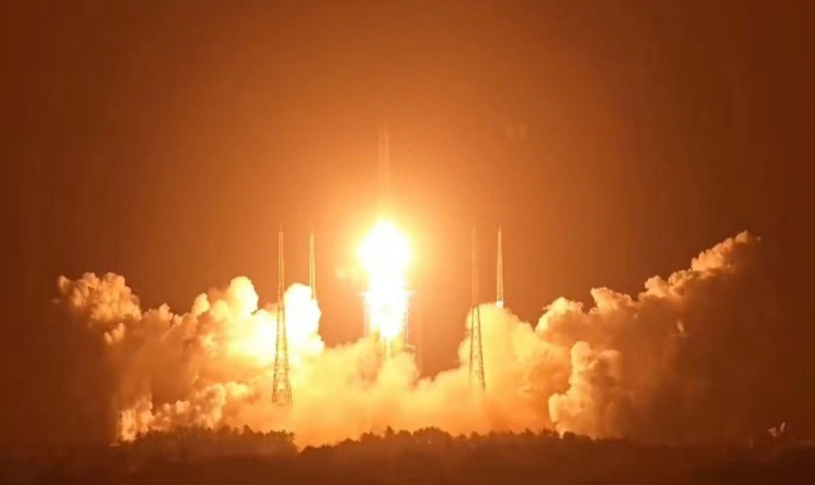

China’s Long March-5, the country’s most powerful carrier rocket, initiated its seventh flight on Friday, marking the first space launch in the Year of the Dragon. The successful launch took place at the Wenchang Space Launch Site in Hainan Province, sending the communication technology experiment-11 satellite into a preset orbit.
Developed by the China Academy of Launch Vehicle Technology (CALT), the Long March-5 is anticipated to enter a high-frequency launch period over the next two years. Lou Luliang, deputy chief designer of the Long March-5, revealed plans for four launch missions this year and a continued high-frequency schedule in the coming years, emphasizing the rocket’s pivotal role in China’s space exploration initiatives.
With a 5-meter diameter core stage, the Long March-5 stands as the largest active Chinese rocket, featuring boosters with a 3.35-meter diameter. Lou noted the intense workload for its assembly and testing, equivalent to 2.5 to 3 times that of conventional rocket models.
Remarkably, only 70 days have elapsed since the last orbital launch by the Long March-5 in December 2023. In that mission, the rocket utilized an extended 18.5-meter fairing, setting a new height benchmark for China’s operational carrier rockets. The longer fairing enhances payload capacity and mission adaptability.
Lou highlighted the reduction in launch site preparation time from over two months to 43 days, with further plans to reduce working time to 30 days next year, streamlining subsequent missions.
Since its maiden flight in 2016, the Long March-5 has played a crucial role in various missions, including the Tianwen-1 Mars probe, Chang’e-5 lunar probe, and the China Space Station’s Tianhe core module. The rocket’s high-frequency launches signify increased efficiency and capability in China’s space exploration projects, indicating the growing robustness of the country’s space capabilities.
A senior space expert noted the significance of these frequent launches, showcasing China’s improved launch efficiency and the increasing number of large payloads and spacecraft. The Long March-5’s success contributes to the advancement of Chinese carrier rocket technology, paving the way for the development of new-generation carrier rockets with greater thrust.
The Long March-5’s integral role in constructing and supporting the China Space Station and participating in lunar exploration projects underscores its importance in China’s space endeavors, signifying a significant leap in carrier rocket technology.