
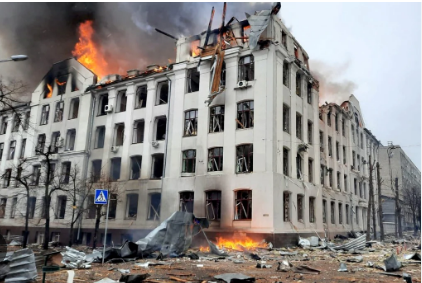

The United States has joined the European Union (EU) and the United Kingdom in announcing a fresh wave of sanctions against Russia, just ahead of the two-year anniversary of the military conflict between Russia and Ukraine that commenced in February 2022. Despite these sanctions, Russia appears to be gaining ground on the battlefield, achieving a recent victory by capturing Avdiivka, a strategically significant town in eastern Ukraine.
Analysts suggest that due to the perceived ineffectiveness of previous sanctions and the unwillingness of the US and the West to compromise with Russia in 2024, a prolonged stalemate is increasingly likely, with a ceasefire still distant. While the US benefits from the ongoing conflict, whether through leveraging Europe for bloc confrontation or selling gas and arms to the continent, experts caution that if the Russia-Ukraine conflict persists, it could be a protracted war without winners. China continues to advocate for peace talks and an early ceasefire.
Stalemate Anticipated to Persist
On Friday, US President Joe Biden announced over 500 new sanctions targeting Russia, focusing on the ongoing war with Ukraine and the death of Russian opposition leader Alexei Navalny. The US also plans to impose new export restrictions on entities supporting Russia and reduce Russia’s energy revenues further.
The latest US sanctions align with moves by its allies, as the UK unveiled more than 50 additional sanctions against Russia, while the EU approved its 13th package of sanctions, targeting nearly 200 individuals and entities allegedly linked to Moscow’s operation. Despite these measures, experts observe that previous Western sanctions have failed to significantly impact Russia. Moscow remains politically and financially resilient, with vast supplies of oil and natural gas contributing to its strength.
The recent sanctions focus on indirect measures, restricting Russia’s trade and financial contacts globally, narrowing its external economic activity. However, Russia’s recent battlefield success, capturing Avdiivka, indicates an advantageous position, with Ukraine facing ammunition shortages and insufficient troops.
Russian Security Council Deputy Chairman Dmitry Medvedev expressed confidence in continuing the “special operation” until taking key Ukrainian cities. While some believe Russia has “regained momentum,” Chinese experts anticipate the seesaw battle to persist in 2024.
While the US and the West remain uncompromising, Ukraine’s passive stance on the battlefield is unlikely to lead to a rout. The extension of 50 billion Euros in aid from the EU to Ukraine signals ongoing Western support.
War Without Winners
Amid the latest sanctions, Chinese companies faced inclusion in British and EU sanctions against Russia, leading to strong opposition from the Chinese Embassy in the UK. As Western media expresses concerns over China’s stance, experts affirm China’s commitment to promoting peace talks and maintaining a neutral position.
The ongoing conflict has negatively impacted major economies, including China, affecting security environments and economies while straining China-EU and China-US relations. While the US benefits in the short term, experts emphasize the conflict’s long-term consequences, predicting a war without winners.
If the US aims to weaken Russia by depleting Ukraine entirely, the outcome may lead to deeper strategic confrontations. Waiting for Ukraine’s exhaustion before engaging Russia on the battlefield could escalate into nuclear war and World War III, causing widespread disaster and tragedy for humankind. Experts caution against playing with fire in such a volatile geopolitical scenario.