
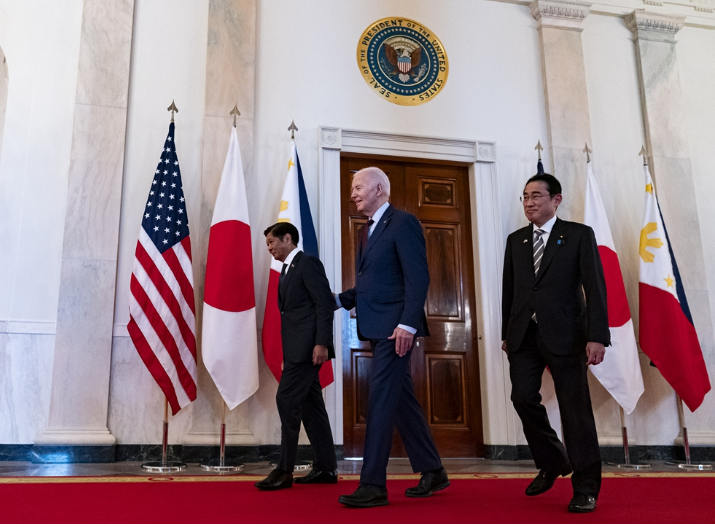

In a recent development, Chinese authorities have voiced strong opposition to the highly targeted summit held in Washington by the United States, Japan, and the Philippines. The trilateral summit, aimed at bolstering military ties to counter what was termed “China’s threats,” has drawn sharp criticism from Chinese officials who accuse the participating countries of undermining regional peace and stability.
Labeling the summit as an “anti-China gathering,” analysts suggest that it signifies a step towards the US’ objective of establishing a mini-NATO in the Asia-Pacific region. However, despite the alliance’s firm commitment, there are concerns about its solidity in contrast to China’s unwavering determination to safeguard sovereignty and regional stability.
Chinese Foreign Ministry Spokesperson Mao Ning emphasized China’s strong opposition to bloc politics and any actions that escalate tensions or harm other countries’ strategic security and interests. She highlighted certain countries’ provocations at sea and their attempts to form exclusive groupings in the region as detrimental to stability.
Addressing the US, Japan, and the Philippines’ accusations, Mao reiterated China’s stance on the Taiwan issue and its indisputable sovereignty over Diaoyu Dao and associated islands. Additionally, Liu Jinsong, Director General of the Department of Asian Affairs at the Chinese Foreign Ministry, summoned Japanese and Philippine diplomats to express serious concerns over their negative actions during the summit.
Senior Colonel Wu Qian of China’s Ministry of National Defense asserted that defense cooperation should not target specific countries or undermine regional peace. He defended China’s activities in the South China Sea as justified and lawful, contrasting them with what he deemed as irresponsible and dangerous actions by a certain non-regional country.
The trilateral summit between US President Joe Biden, Japanese Prime Minister Fumio Kishida, and Philippine President Ferdinand Romualdez Marcos Jr focused on enhancing defense ties aimed at China. The joint statement released by the White House expressed “serious concerns” over China’s actions in the South China Sea and the East China Sea, as well as reaffirming support for Taiwan’s peaceful resolution.
The establishment of a trilateral maritime dialogue and plans for joint maritime activities signal a strengthening of cooperation among the three countries. However, Chinese analysts see this as a provocative move that could escalate tensions in the region.
The summit’s implications for regional dynamics are significant, with the US seeking to consolidate alliances to counterbalance China’s influence. However, there are concerns about disparate calculations among US allies and potential repercussions for regional stability.