
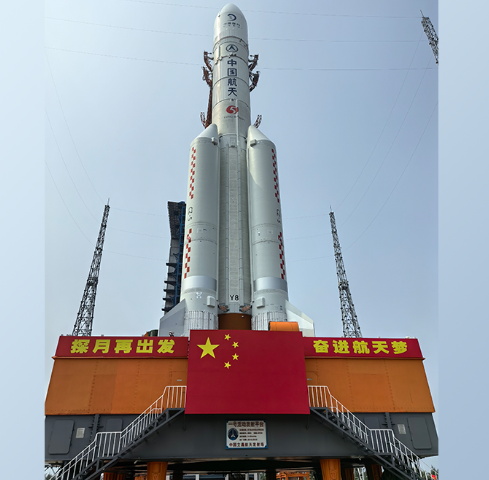

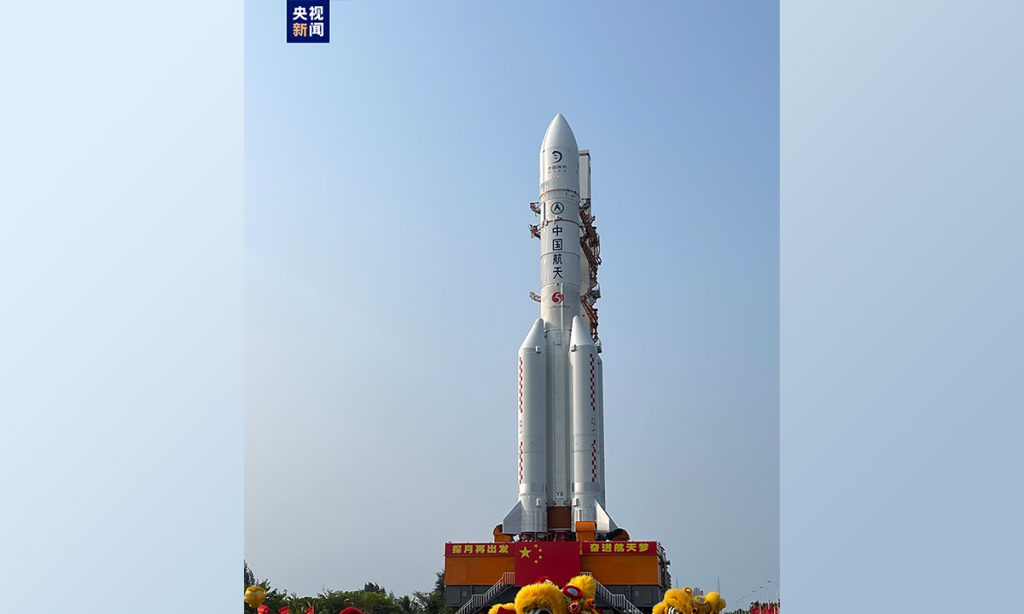
China’s Chang’e-6 lunar probe, paired with the Long March-5 Y8 carrier rocket, has been transported to the Wenchang Space Launch Site in Hainan Province, as confirmed by the China National Space Administration (CNSA) on Saturday. The scheduled launch is set for early May.
Both the Chang’e-6 lunar probe and the Long March-5 Y8 carrier rocket arrived at the launch site in January and March, respectively, completing assembly and testing phases, according to CNSA. The forthcoming tasks include various functional checks, joint tests, and propellant loading.
The upcoming mission marks the world’s first attempt to collect material from the dark side of the moon for return to Earth. Estimated to yield approximately 2,000 grams of lunar samples, surpassing the 1,731 grams retrieved during the Chang’e-5 mission, this endeavor holds significant scientific promise.
In a notable shift, NASA has authorized space agency-funded researchers to apply for access to China’s lunar samples, bypassing the Wolf Amendment. NASA expects these samples to offer valuable insights into the geological history of the moon, informing future lunar exploration plans.
As part of the Chang’e series, China recently launched the Queqiao-2 relay communication satellite to facilitate communications between the far side of the moon and Earth. The mission was declared a complete success following a series of in-orbit communication tests.
The Chang’e-6 mission is integral to China’s Phase-4 lunar exploration program, aimed at advancing planetary exploration and enhancing space launch capabilities over the next 15 years. China aims to land a Chinese national on the moon by 2030.
Moreover, China disclosed plans for the International Lunar Research Station (ILRS), co-led with Russia, to be constructed in two phases. The first phase involves establishing a basic station equipped with comprehensive scientific facilities in the lunar south pole region by 2035. The second phase includes expanding the station with a moon-orbiting space station as the hub, slated for completion by 2045.
Recent developments include the addition of three new members to the ILRS program, bringing the total to nearly 20 countries and organizations. China aims to welcome 50 countries, 500 international research institutions, and 5,000 overseas researchers to the ILRS program.
Furthermore, China revealed ambitious Mars exploration plans, with the Tianwen-2 mission slated for around 2025 to conduct a flyby exploration and sample return from a small asteroid. By 2030, the Tianwen-3 mission aims to return samples from Mars, positioning China to become the first country to achieve this milestone.