
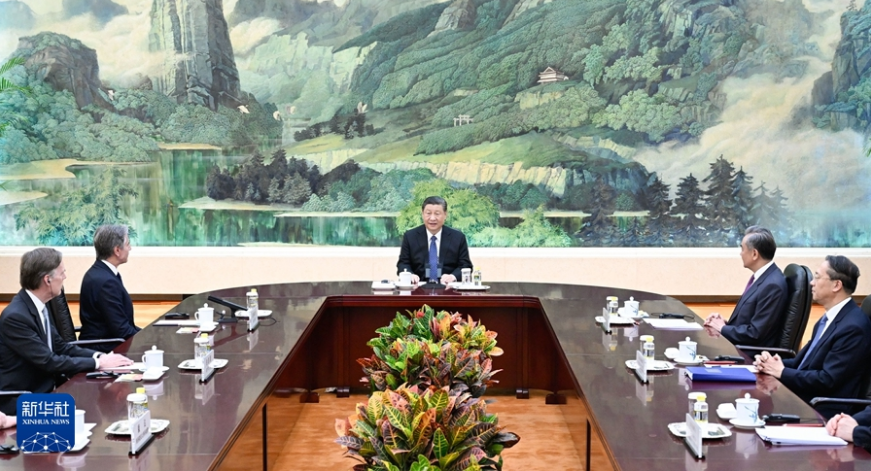

Chinese President Xi Jinping held a meeting with visiting US Secretary of State Antony Blinken on Friday in Beijing, underscoring China’s willingness to cooperate with the US on the condition that cooperation is reciprocal.
Xi Jinping expressed China’s contentment in seeing a confident, open, prosperous, and thriving US and hoped for a reciprocal attitude towards China’s development. He emphasized the importance of addressing this fundamental issue to stabilize, improve, and advance China-US relations.
Highlighting China’s commitment to non-alignment, Xi Jinping urged the US to refrain from forming exclusive cliques, emphasizing the importance of maintaining their own friends and partners without targeting or opposing each other.
During the meeting, diplomatic teams from both sides reached five points of consensus, including maintaining high-level exchanges and contact, continuing military exchanges, and furthering cooperation in areas such as drug prohibition, climate change, and artificial intelligence.
Some Chinese experts described President Xi’s meeting with Blinken as a top-level reception, emphasizing the need for the US to rectify inaccuracies and biases in its foreign policy toward China.
Blinken assured that the US is not seeking a “new Cold War” or seeking to change China’s system, contain its development, oppose it through alliances, or engage in conflict. He reiterated the US commitment to the one-China policy and expressed a desire to maintain communication with China.
The latest communication between the two nations is viewed as a process of mutual reassurance by experts. They stressed the importance of pragmatically advancing this reassurance process to ensure stable, mutually beneficial, and cooperative relations between China and the US.
However, concerns persist among experts regarding whether the US can effectively manage differences and expand cooperation through action, especially amid ongoing elections. Negative US actions, such as arms sales to Taiwan and the targeting of China’s human rights and governance in Xinjiang, contribute to uncertainty in bilateral relations.
While the overall trend in bilateral relations may be stable, significant risks remain, primarily due to domestic political constraints on the White House regarding China policy.