
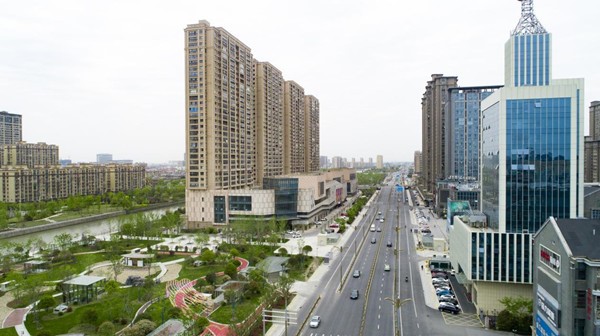

In a strategic move to enhance its urban capacity and appeal, the county-level city of Taixing in East China’s Jiangsu province has made transportation infrastructure a cornerstone of its urban development plans. The city’s focus on improving its road network is set to address long-standing traffic issues, enhance connectivity, and boost overall urban mobility.
At the construction site of the Xingyan South Extension Project, workers are busy laying down road paving, signaling the city’s commitment to overcoming traffic bottlenecks and narrow roads. Once completed, the extension will significantly alleviate congestion, improving travel conditions for local residents and easing long-term traffic frustrations in the area.
The project is part of Taixing’s broader plan to modernize and optimize its transportation network. By improving road connectivity and addressing the city’s urban mobility pain points, the city is enhancing the efficiency of transportation and making it more convenient for residents to move around.
Addressing Long-Standing Traffic Bottlenecks
Taixing has long faced challenges with its transport infrastructure. “There used to be some local jokes about Taixing’s transport, saying that ‘the Long March Road isn’t long, the Tongjiang (Lake Connection) Road cannot connect, the Daqing (Grand Celebration) Road isn’t grand, and the Jiangping (Smooth Lake) Road isn’t smooth’,” said Zhu Wei, section chief for urban-rural construction at the Taixing Housing and Urban-Rural Development Bureau.
To resolve these issues, the city has undertaken targeted planning and reconstruction projects. One such initiative is the Long March Road South Extension Project, launched in November of last year. This critical north-south arterial road, located in a densely populated commercial area of the old city, had long struggled with connectivity issues and traffic bottlenecks. Now, with the South Extension open to traffic, the road links five surrounding routes, significantly enhancing the city’s road network and easing congestion.
Expanding and Upgrading the Road Network
Taixing’s ongoing infrastructure development goes beyond just road expansion. Since the beginning of this year, the city has initiated the reconstruction and expansion of 14 major roads, including the Xingyan South Extension, to alleviate traffic bottlenecks and improve overall travel efficiency. These efforts are aimed at creating a more fluid urban transport system and enhancing the quality of life for residents.
In addition to expanding roadways, Taixing has focused on improving its overall travel environment. The city has been upgrading key infrastructure, such as rainwater and sewage pipelines, along major roads like Guoqing Road and Xingyan Road, to ensure that its transport network can cope with growing demands. Efforts to address waterlogging at intersections like Wenjiang Road and Yunhe Road are also underway, with additional improvements in wastewater treatment planned for designated areas.
A Vision for Future Growth
With a clear focus on transportation as a vital aspect of urban development, Taixing is positioning itself for future growth. By upgrading its transport infrastructure, the city is not only improving the daily commute for its residents but also laying the groundwork for greater economic activity and regional connectivity. As the city continues its road and infrastructure upgrades, the vision is clear: a modern, efficient, and well-connected Taixing that supports sustainable urban growth and enhances the quality of life for its people.