
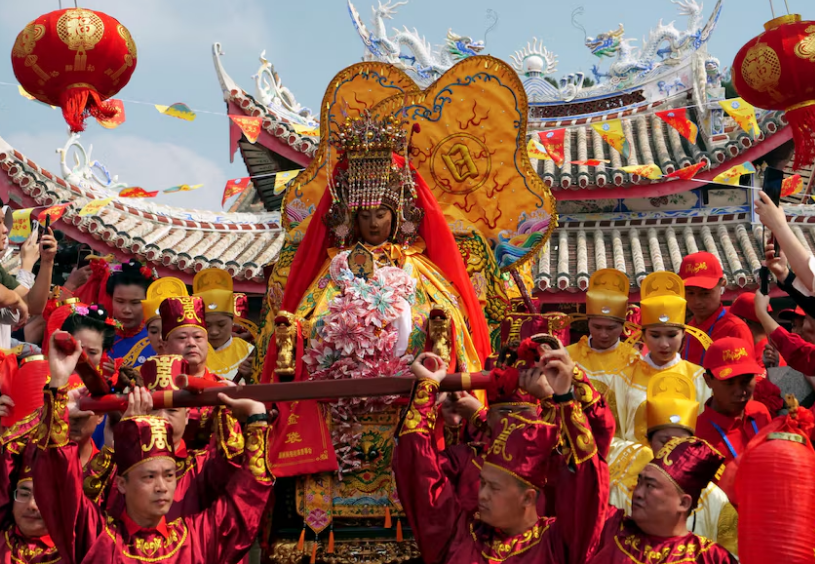

A new academic study has found that China is increasingly using religion as a soft-power tool to court Taiwanese worshippers, part of a wider campaign to win hearts and minds across the Taiwan Strait.
The report, released this week by a Taiwan-based research institute, details how Beijing has intensified its outreach to Taiwanese pilgrims, sponsoring temple visits, religious exchanges, and cross-strait festivals in a bid to foster cultural affinity.
According to the study, Chinese authorities have funded the restoration of several temples associated with deities popular in Taiwan, such as Mazu, the sea goddess revered by millions of Taiwanese Buddhists and Taoists. These initiatives, analysts say, are designed to project a sense of “shared heritage” and “spiritual unity” under the banner of Chinese civilization.
“The strategy is subtle but deliberate,” said Dr. Lin Pei-chun, one of the study’s lead researchers. “By appealing to faith and culture rather than politics, Beijing is attempting to create emotional connections that make political unification appear more natural.”
The study also notes that thousands of Taiwanese devotees travel annually to Fujian and other coastal provinces for temple festivals journeys that are often facilitated by Chinese officials offering free accommodation, transportation, and media coverage.
Critics in Taipei have warned that such religious diplomacy could blur the lines between cultural exchange and political influence. Taiwan’s Mainland Affairs Council has urged religious organizations to remain vigilant, emphasizing the risk of Beijing using faith-based networks to spread propaganda or gather intelligence.
For Beijing, however, religion has emerged as an unexpected diplomatic frontier—a softer, more spiritual approach to the long-contested goal of reunification.