
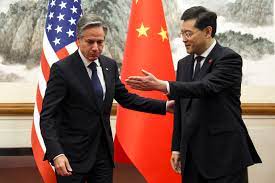

Tensions between China and the United States have shown no immediate signs of de-escalation following US Secretary of State Antony Blinken’s recent visit to China. Both countries have been observed deploying warships and warplanes, including aircraft carriers, in sensitive waters near the Taiwan Straits and the South China Sea over the past few days.
Experts have expressed that if the US genuinely wishes to control the risk of accidents or engage in dialogue, it should refrain from contradictory actions and military provocations near China. On Friday, the US Navy’s USS Ronald Reagan, the only forward-deployed aircraft carrier, was reported to be operating in the South China Sea, as stated in a press release by the Pentagon’s Defense Visual Information Distribution Service.
Media reports have indicated that the Ronald Reagan Carrier Strike Group, following joint exercises with Japanese, French, and Canadian ships in the East China Sea and the Philippine Sea, has been active in the South China Sea since last week. It is scheduled to make a rare port call in Vietnam on Sunday.
Earlier in the week, the US Coast Guard Cutter USCGC Stratton transited through the Taiwan Straits, closely monitored by vessels of the China Coast Guard (CCG), according to Gan Yu, a spokesperson for the CCG. Additionally, the Taiwan defense authority reported the sighting of the People’s Liberation Army (PLA) Navy’s Shandong aircraft carrier group sailing through the Taiwan Straits into the South China Sea.
MizarVision, a Chinese technology and intelligence company, noted that several US spy planes, including a P-8A maritime patrol aircraft, an EP-3E electronic reconnaissance aircraft, an RC-135 reconnaissance aircraft, and a suspected drone, were observed operating in the South China Sea near the southern end of the Taiwan Straits. These observations were based on open-source flight data.
A military expert based in Beijing, who preferred to remain anonymous, stated that the recent movements of the aircraft carrier Shandong were part of a routine training mission and unrelated to the current situation in the Taiwan Straits or the South China Sea. However, the carrier’s presence serves as a deterrent against forces advocating “Taiwan independence” and external interference, as well as a response to US military provocations in the region, the expert added.
Although Blinken’s visit to Beijing concluded with an agreement to stabilize bilateral relations and maintain open communication, the ongoing military activities of US aircraft carriers, cutters, and spy planes near China indicate that tensions between the two countries persist. Observers have criticized the US for making claims about stabilizing China-US ties while simultaneously engaging in actions that raise tensions.
Li Haidong, a professor at the China Foreign Affairs University, stated that the US actions, which disregard China’s sovereignty, security, and interests, are dangerous. Such provocative moves could lead to further deterioration in China-US relations, placing the responsibility on the US to bear.
China recently honored a PLA Air Force unit for its activities, including breaking through the first island chain into the Pacific Ocean, conducting nighttime encirclement flights near Taiwan, patrolling the South China Sea, and expelling foreign vessels illegally entering Chinese waters with H-6K bombers over the years.
Analysts assert that the Chinese military possesses the capability, determination, and confidence to resolutely safeguard national sovereignty, security, and development interests. With its comprehensive system encompassing land, sea, air, space, electromagnetic space, and cyberspace, China can counter external interference forces near its borders, whether in the vicinity of Taiwan or in the South China Sea, regardless of coast guard cutters or aircraft carriers.