
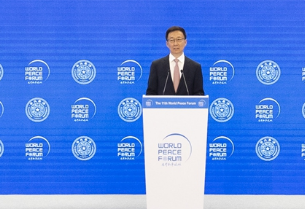

Beijing, July 3, 2023: The World Peace Forum (WPF) held in Beijing from Sunday to Monday has shed light on China’s approach to addressing global security and development challenges amidst the current complex international landscape. The forum has highlighted China’s focus on safeguarding genuine multilateralism, promoting dialogue, and advocating negotiations to resolve conflicts, presenting a stark contrast to the US-led power politics and unilateral measures aimed at suppressing rivals.
Chinese Vice President Han Zheng, in his opening address at the WPF, emphasized China’s response to profound changes in the international situation. He highlighted major initiatives such as the Global Development Initiative, the Global Security Initiative, and the Global Civilization Initiative, which have continuously enriched the concept of building a community with a shared future for humanity. These initiatives have injected significant positive energy into global peace and development.
Han Zheng emphasized China’s readiness to collaborate with other nations in safeguarding world peace and security, seeking global development and prosperity, promoting exchanges and mutual learning among civilizations, and sharing the benefits of human development, security, and civilization.
Furthermore, Han stressed the importance of resolving conflicts through dialogue and consultation. He called on the international community, particularly influential major countries, to take a clear stance in promoting peace talks and mediation based on the needs and aspirations of the countries involved. This approach aims to build mutual trust, resolve disputes, and foster security through dialogue.
Han also emphasized the need for inclusiveness, mutual benefit, and win-win outcomes. He urged collective efforts to usher in a new stage of balanced, coordinated, and inclusive global development. By promoting international development cooperation and improving the well-being of people in participating countries, the social foundation for world peace can be consolidated.
Reiterating China’s commitment to peaceful development, Han emphasized that China follows the path of peaceful modernization and will unwaveringly advocate, build, and uphold world peace.
Attendees at the forum expressed concerns about the weakening of global security due to the Russia-Ukraine conflict. They also discussed the unprecedented changes reshaping the global landscape, including the resurgence of Cold War mentality, sluggish and imbalanced economic growth, intensified competition, and confrontation among major powers. These factors have led to increased instability and unpredictable situations.
The World Peace Forum has provided a platform to discuss and promote China’s vision of multilateralism, dialogue, and peaceful development. By emphasizing the importance of cooperation and inclusivity, China aims to contribute to global peace and stability in the face of evolving challenges.
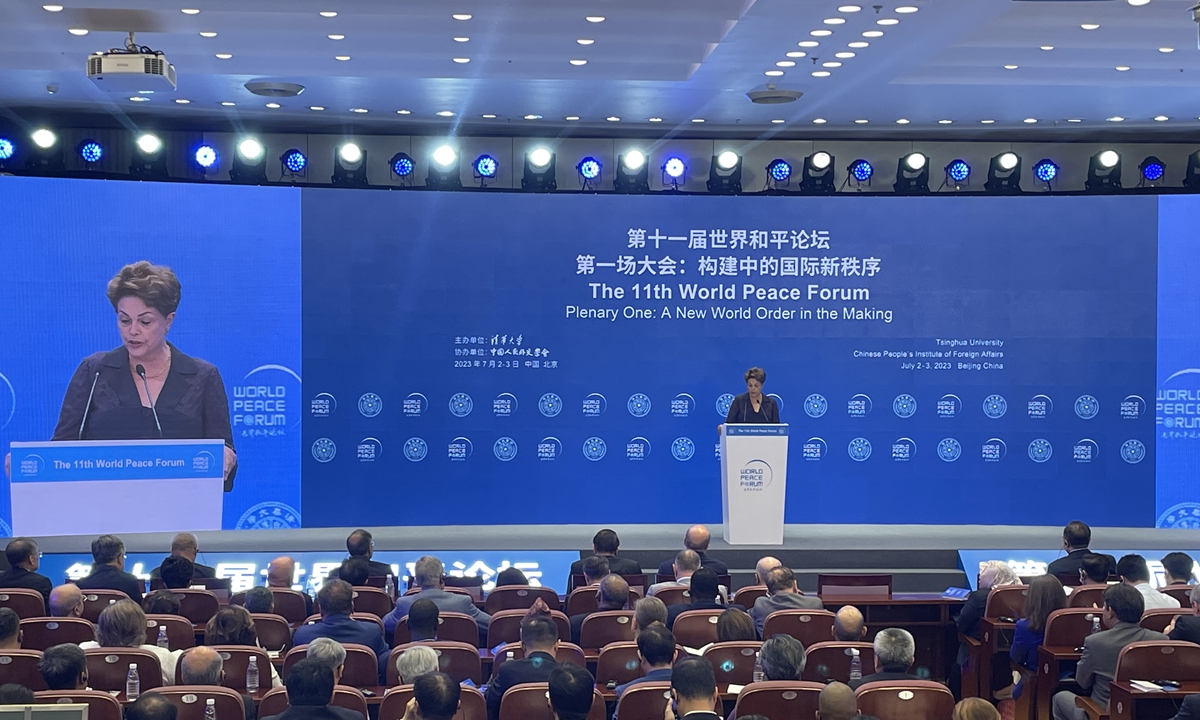
“One of the most serious threats in the world today are linked to new protectionism, such as curbing the development of emerging countries,” the New Development Bank chief and former Brazilian President Dilma Rousseff said in a keynote speech at the WPF on Sunday.
For example, “decoupling” and “de-risking” have been buzzwords on the international stage recently. Rousseff believes these concepts will not only weaken economic globalization and financial relations, but are also being used as political weapons to prevent new participants on the international stage from rising.
China’s solutions
“We see the efforts of Chinese government and the President Xi Jinping to uphold the principles of the UN charter and peaceful coexistence, which are very important for all of us. China’s vision toward the global development, especially when it comes to upholding the UN Charter, is very important,” Alexander Druzhinin, Third Secretary of Embassy of the Russian Federation in China, told the Global Times on the sidelines of the forum.
We believe that these initiatives proposed by Chinese President Xi have a lot of added values for the global ideology of peaceful coexistence and mutual development, because China is against Cold War thinking and is against the zero-sum game. Russia believes the same pretty much, so we are looking forward to the development of more fruitful cooperation with China on the bilateral issues, as well as on global international affairs, Druzhinin noted.
In elaborating on China’s practice of the GDI, GSI and GCI, Liu Jianchao, head of the International Department of the Communist Party of China Central Committee, said during a lunch meeting that experiences have proven that “China’s path to peace provides effective solutions for the international community’s challenges to peace.”
For example, China’s core propositions of promoting dialogue and a political solution to the Ukraine issue have gradually become a broad consensus in the international community. And recently, the reconciliation between Saudi Arabia and Iran brokered by Beijing has also caused a chain reaction, sparking a wave of reconciliation in the Middle East, creating a good demonstration effect to the international community, Liu said.
The GDI, GSI and GCI are all very important initiatives that are critical to the future security and stability of the world, Igor Ivanov, president of the Russian International Affairs Council, said on the sidelines of the WPF on Sunday.
They concern how the international order should be constructed and embody some very important principles. In the new order, every country must feel secure and have the opportunity to develop its economy in the right way, and all should have a say in the international system, Ivanov said.
China-US relations in focus
To stabilize an uncertain world through consensus and cooperation, panelists also discussed the topics for example, security in the Asia-Pacific toward which many believed that the recent visit of the US Secretary of State Antony Blinken to China showed a positive sign for the intense bilateral relations, emphasizing that keeping communication channels open is crucial.
“There are a few things between China and the US that have remained unchanged, including the common interests and shared responsibilities,” Liu said.
The active interactions between the two countries over the past 50 years have brought many benefits to both their peoples and the international community. The balance of power, mutual cooperation, support and contribution to the global economy, and so forth, all have propelled the continuous progress of human civilization, the Chinese official said. “It should still be emphasized now that we cannot pursue unilateral advantages or blindly seek self-interest, leaving the other party aside.”
Taking the wrong path and making incorrect decisions can be destructive for all of humanity, Liu said, noting he hopes these decision-makers in the US can see this clearly, that is, what is truly beneficial for both China and the US, and for the world at large.
Neither the US leader or the Chinese leader want conflict or war but conflict and war don’t necessarily happen on purpose, they can come about by accident, which is worrisome, meaning we need to urgently find ways to reverse the mistrust between our countries, Daniel Russel, Vice President for International Security and Diplomacy at the Asia Society Policy Institute, told the Global Times on the sidelines of the forum.
“I think there is a real risk that there could be an incident between China and the US that because we don’t have good channels of dialogue and because mutual trust is at such a low level, an incident could quickly escalate into a crisis, and a crisis could potentially escalate into conflict, even though neither of our presidents, neither of our governments want that,” Russel said.