
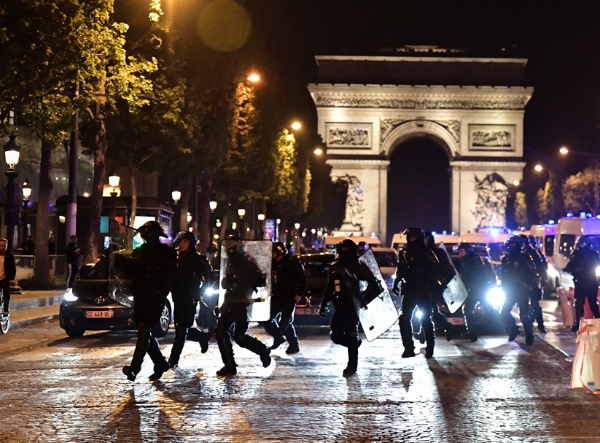

Paris, July 3, 2023: The ongoing riots across France have led to the postponement of French President Emmanuel Macron’s state visit to Germany, which was scheduled to begin on Sunday. With over 45,000 police officers deployed to handle the situation and hundreds of arrests made, the impacts of the massive unrest are extensive. Chinese nationals and observers residing in France have expressed concern about the damage caused and are hopeful that public order can be restored. They condemn the attacks on innocent civilians and public facilities as unacceptable.
Chinese tourists planning to visit France are also worried about the riots. The Chinese Foreign Ministry issued a warning on Sunday regarding the current security situation in France. Chinese analysts have attributed the riots to long-standing issues related to immigration and Europe’s worsening economic situation due to the Ukraine crisis. They suggest that Macron’s recent efforts to seek strategic autonomy and promote a multi-polar world order may have offended forces supporting a hegemonic unipolar order, implying their potential involvement in the unrest.
The unrest and violence witnessed in France are not limited to the country alone. Similar incidents have been reported in other European countries, including Switzerland and Belgium. Experts believe that this indicates a shared challenge faced by EU members, putting France and the EU to the test in handling this complex situation.
The dangerous situation has resulted in the arrest of at least 719 people during the fifth night of uprisings across France on Saturday. The violence began after the funeral of 17-year-old Nahel M, a North African descent, who was fatally shot by a police officer during a traffic stop in the Paris suburb of Nanterre on Tuesday. While the level of violence appeared to have declined since the initial outburst of anger, communities with a significant population of Muslims and immigrants have been predominantly affected. Rioters have targeted public transportation systems, scenic spots, and shopping centers, using the chaos as an opportunity for looting.
Despite the unrest, communities with fewer immigrants have remained relatively safe, as riots and unrest are not uncommon in France. While some believe the situation will eventually return to normal, they express doubts about solving the underlying issues related to immigrants and police violence.
Foreigners in France, including Chinese tourists, face risks. On Friday, a bus carrying 41 Chinese tourists was attacked by a group of rioters in Marseille. As a result, the Chinese Foreign Ministry has urged Chinese nationals in France to enhance their personal, vehicle, residence, and shop security and provided emergency contacts.
The unrest has also impacted diplomatic activities involving the French president. Macron’s state visit to Germany has been postponed, following an earlier cancellation of a visit by Britain’s King Charles due to protests over pension legislation.
Chinese travel agencies are closely monitoring the situation, but they have not yet canceled trips to France. They will adjust travel itineraries based on developments, considering the riots as isolated incidents that will not last long.
The riots, triggered by the killing of a North African teenager by French police, are a manifestation of long-standing and complex problems in France, according to Zheng Ruolin, an expert on French studies. Tensions arising from cultural, ethnic, and religious differences, as well as the strained relationship between police and immigrants, have been exacerbated by the influx of refugees and immigrants from developing countries. The Ukraine crisis further amplified economic challenges and discontent among the lower classes, particularly immigrants from Arab and African countries.
While no clear evidence supports the speculation, observers suggest that forces opposed to Macron’s independent stance from the US may have played a role in the riots to create trouble and pressure his government. The use of social media networks among rioters and the presence of seditious political slogans have drawn comparisons to color revolutions.
Experts warn that if the riots spread to other European countries,