
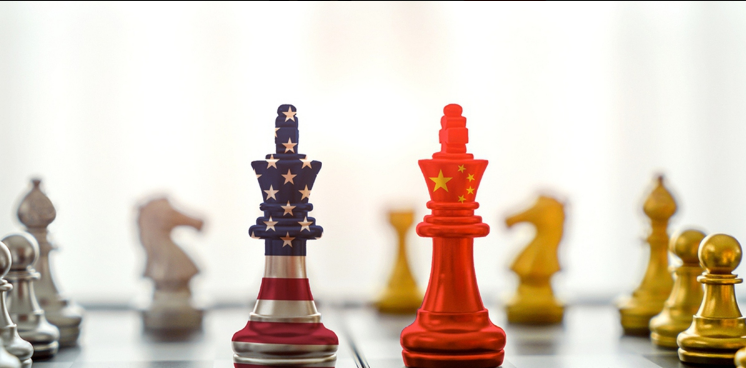

In a recent development, the United States has made several “friendly” gestures toward China. However, Chinese analysts remain skeptical of the true intentions behind the rhetoric emanating from certain senior US officials. They argue that while the US talks about “de-risking,” it is essentially a guise to pursue a strategy of “de-China” in specific sectors such as investment, technology, and industry layout, while also attempting to influence its allies to follow suit.
The director of the US Central Intelligence Agency (CIA), William Burns, addressed this issue during a lecture at the Ditchley Foundation in the United Kingdom. He cautioned against a complete “decoupling” from China, calling it “foolish” due to the deep economic interdependence. Instead, Burns advocated for “de-risking” and diversifying supply chains as a more viable approach.
While some US politicians have realized the impracticality of “decoupling” and have attempted to distance themselves from the term in policy documents and speeches, there are hawkish forces that continue to push for “decoupling” under alternative labels like “de-risking.” Analysts argue that despite the rebranding, this strategy ultimately aims to contain China’s economic and technological rise.
Li Haidong, a professor at the China Foreign Affairs University, observed that the US abandoning the “decoupling” narrative reflects a realization in the Biden administration that such a harsh approach would harm the US economy and isolate the superpower with limited support from allies. However, there remains a disparity in perception between the US and its allies regarding the concept of “de-risking.” For the US, it involves separating specific technologies, investments, and industrial layouts from the Chinese market while persuading allies to do the same.
“De-risking, for the US, is essentially about reducing its reliance on China,” Li stated. However, major European countries view de-risking as a means to enhance the resilience of their supply chains and related industries.
Chinese analysts dismissed the positive signals conveyed by Burns’ speech in the UK as mere “lip service,” given the series of measures targeting China that the US has recently implemented. Last month, the US government added 43 entities, including 31 from China, to its export control list, citing concerns over national security threats posed by these entities, including alleged training activities for Chinese military pilots.
In a separate event, US President Joe Biden met with China’s new Ambassador to the US, Xie Feng, in the Oval Office of the White House. Xie expressed hope for the US and China to work together based on the understandings reached during the Bali Summit in late 2022, with the aim of stabilizing and redirecting the China-US relationship.
While some analysts viewed the quick acceptance of Xie’s credentials and the Oval Office meeting as a gesture of friendship and respect from Biden towards China, others noted the complexity of the Biden administration’s approach. Biden seeks to contain China’s development and expand US influence, yet he also desires a less confrontational bilateral relationship. Anonymous Chinese analysts remarked that the US hopes to make the relationship with China “more or less tolerable” on the condition that China compromises further, emphasizing that China cannot succumb to US strategic pressure as it would compromise national interests.
Critics argue that the US lacks self-reflection and empathy in its China policy, and attempts to make China compromise are rooted in a hegemonic logic aimed at overpowering China through strength. However, analysts stress that such tactics are unlikely to succeed, as China will not surrender its national interests to strategic pressure.