
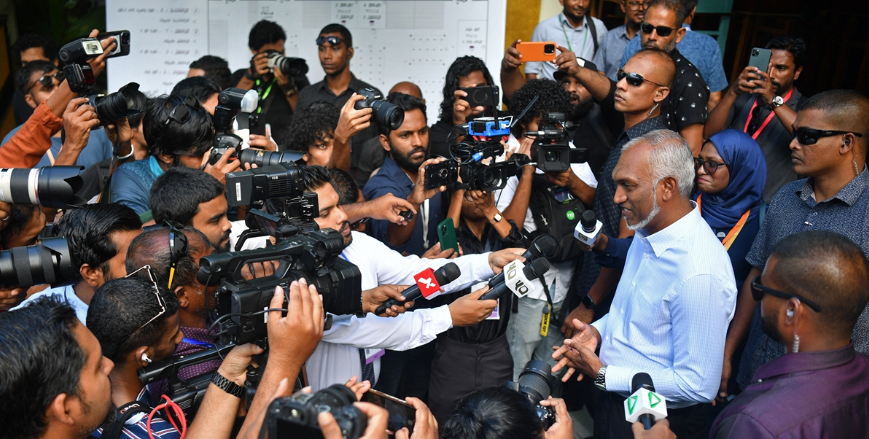

China expressed its felicitations on Monday over the resounding triumph of Maldives President Mohamed Muizzu’s People’s National Congress (PNC) in what some Chinese analysts hailed as a landslide victory. Experts noted the significance of this win in facilitating the smooth execution of Muizzu’s domestic and foreign agendas, asserting its potential to bolster Maldives-China ties and ensure stability in bilateral relations.
Nevertheless, certain Western and Indian media outlets have closely monitored the election, amplifying narratives of China’s expanding influence in the Indo-Pacific. Experts attributed this narrative to a “sour grapes” mentality, emphasizing the election’s indication of the Maldives’ prioritization of economic development over geopolitical entanglements.
According to reports from local news site Sun Online, over 200,000 Maldivians participated in Sunday’s parliamentary elections, witnessing 326 candidates vying for 93 parliamentary seats, including six new positions. Preliminary results revealed PNC’s acquisition of 68 seats, securing a decisive majority in the Maldivian parliament.
The election results garnered extensive attention from Western and Indian media, with Reuters highlighting Muizzu’s divergence from the “India First” policy, which strained relations with New Delhi.
Indian media underscored the election’s importance as a litmus test for Muizzu’s agenda to deepen economic and defense ties with China, signaling a shift away from traditional ally India.
Contrary to previous parliamentary standings where the Maldivian Democratic Party, associated with former President Ibrahim Mohamed Solih and perceived as pro-India, held majority control, the party faced a significant decline, securing only 15 seats in the current election.
Experts, including Qian Feng from Tsinghua University, emphasized that PNC’s overwhelming victory fortifies Muizzu’s presidential authority, facilitating the smooth implementation of his policies. Chinese Foreign Ministry spokesperson Wang Wenbin extended congratulations on the successful election, affirming China’s commitment to strengthen bilateral cooperation across various domains.
Tian Guangqiang from the Chinese Academy of Social Sciences stressed the Maldives’ emphasis on economic development over geopolitical maneuvers, with Muizzu’s presidency reflecting public support for such priorities. Muizzu’s recent declaration to restrict Indian military presence in the Maldives underscores his administration’s focus on sovereignty and economic growth.
Liu Zongyi from the Shanghai Institutes for International Studies highlighted Muizzu’s balanced approach towards China and India, urging India to reassess its policies towards the Maldives to foster mutual respect and cooperation.
The election outcome, as Liu noted, reflects popular sentiment and the alignment of Muizzu’s policies with Maldivian interests. Qian emphasized that Maldivian support for enhancing relations with China rebuts recent criticisms from the opposition within the country.
While some Indian media speculate about the Maldives drifting away from India, Chinese experts advocate for India’s introspection regarding its historical approach to the Maldives, urging a shift towards equitable engagement devoid of power dynamics.