
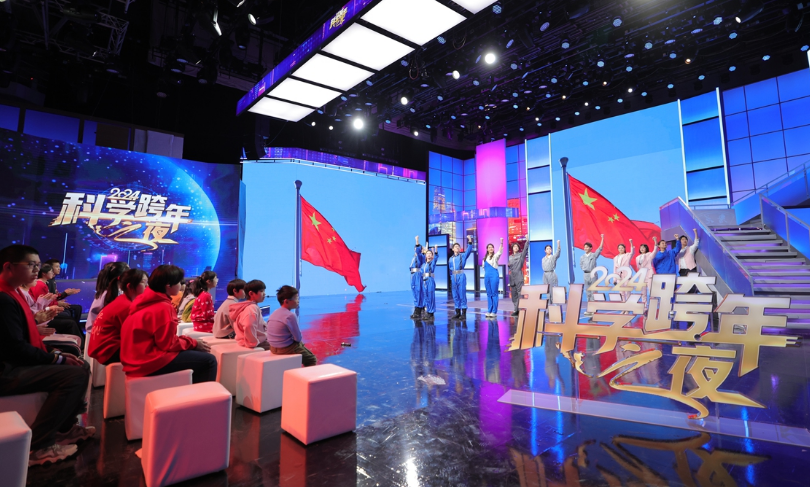

In an engaging New Year’s Eve Event hosted by the Beijing Association for Science and Technology (BAST), experts delved into the connection between a trotting horse lamp and an aero engine, the transformation of Beijing’s air quality, and the impact of AI on daily life. The event, part of the New Year of Science project, aimed to blend scientific communication with festive culture, fostering public confidence in technological advancements. Scientists shared insights, experiences, and future aspirations, covering diverse fields.
Wang Jingxiu: Illuminating the Sun’s Secrets
At the New Year of Science Eve Event, Wang Jingxiu, an academician at the Chinese Academy of Sciences, shared his 45-year journey studying the sun. Recognizing the sun’s vital role in creating and sustaining life, Wang emphasized China’s leading position in solar physics, particularly in solar activity and magnetic field research. China’s recent accomplishments, including the Xihe and Kuafu satellites, mark a new era in solar exploration, with Wang envisioning Chinese scientists pioneering observations of the sun’s poles.
Xiao Long: Mars Landing Estimated by 2050
Xiao Long, a planetary geoscientist, anticipates the first human landing on Mars around 2050. Despite advancements in unmanned Mars missions, Xiao highlighted challenges in manned missions, including the need for larger rockets and addressing physiological and psychological issues during interstellar journeys. Mars, akin to Earth, holds scientific significance, and Xiao’s team, analyzing data from China’s Zhurong rover, made groundbreaking discoveries, presenting the audience with a high-resolution image map of Mars.
Pan Weimin: China’s HEPS Project Lighting Up 2024
Pan Weimin, chief manager of China’s High Energy Photon Source (HEPS) project, shared updates on the project during the New Year of Science Eve Event. As the last magnet was installed, marking a crucial milestone, Pan highlighted HEPS as a cutting-edge synchrotron radiation facility, designed to be among the brightest globally. Scheduled to emit its first SR light by the end of 2024, HEPS is expected to significantly enhance China’s scientific and technological standing in X-ray-based research.
Liu Daxiang: Decoding Aviation Engines and Trotting Horse Lamps
Renowned aviation expert Liu Daxiang, in a captivating presentation for children, drew parallels between a trotting horse lamp and aero engines, unraveling the working principles shared by both. Reflecting on his 60-year journey in aircraft engines, Liu emphasized the importance of high-altitude test benches, pivotal for independent aviation engine development in China. Liu’s dedication, spanning decades, culminated in China’s recognition as the fifth country globally with a high-altitude test bench of similar scale.