
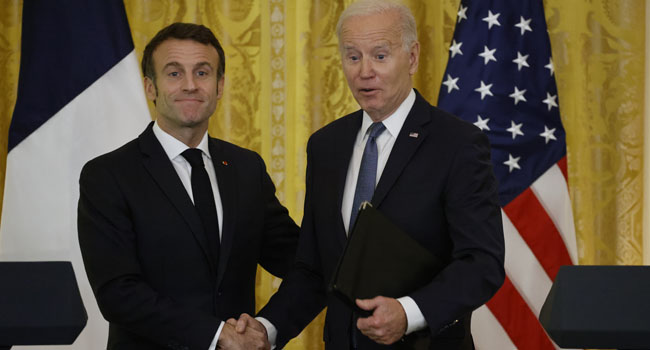

In a significant diplomatic development, US President Joe Biden and French President Emmanuel Macron have focused their attention on China during Biden’s recent visit to France. Amid rising tensions in the Middle East and uncertainties about the future of US alliances, the two leaders addressed key issues involving China, highlighting the evolving geopolitical landscape.
Strengthening Alliances in Europe
Biden’s visit to France comes at a crucial time as the US seeks to fortify its alliances in Europe. This effort is driven by emerging fissures over Middle East conflicts and concerns about former President Donald Trump potentially returning to office. During the visit, Biden emphasized the importance of “free navigation” in the Indo-Pacific and fair economic practices. “In the Indo-Pacific, we stand together for freedom of navigation, transparent governments, and fair economic practices,” Biden stated in a subtle reference to China’s growing influence in the region, according to a White House transcript.
Divergent Strategies in the Indo-Pacific
The US is clearly aiming to consolidate its allies in the Indo-Pacific to support its strategic goals and expand its presence. “The US has a strong intention to bring its allies into the Indo-Pacific region to support its own strategy and to expand its presence,” explained Li Haidong, a professor at the China Foreign Affairs University.
France, however, approaches the Indo-Pacific from a different perspective. “France sees the region as a stage to showcase its status as a major power rather than as a battleground for competing with China,” Li added. This distinction highlights the varied motivations behind the US and French strategies in the region.
Biden’s efforts also appear to be aimed at ensuring continuity in US Indo-Pacific policies, even if Trump were to return to office. “This is a significant action to constrain and limit Trump’s future actions. It reflects a highly opportunistic and power-driven approach,” Li noted.
Addressing Trade Practices and Overcapacity
Macron raised concerns about China’s trade practices and overcapacity during Biden’s visit. “On the economic front, we are both concerned about China’s unfair trade practices, which bring about overcapacity. This is of such importance for the global economy that we have to act in a coordinated fashion,” Macron told reporters.
Recent reports indicate that the European Commission has delayed its decision on Chinese electric vehicles (EVs), underscoring the potential unintended consequences of imposing tariffs. Although Macron did not directly mention China’s EV industry, his comments likely target this sector, given the recent European threats of tariffs on Chinese EVs.
Balancing Trade and Protectionism
Macron’s statements reflect France’s nuanced stance on economic and trade cooperation with China. On one hand, France seeks to boost trade with China to export more aircraft and agricultural products. On the other hand, France exhibits protectionist tendencies, having supported the EU’s anti-subsidy investigations into Chinese EVs.
Sun Yanhong, a senior research fellow at the Institute of European Studies of the Chinese Academy of Social Sciences, criticized Western claims of overcapacity in China’s EV sector as groundless. “European imports of EVs from China are a purely commercial activity, driven by real demand,” Sun asserted. She added that Chinese EV makers could play a crucial role in helping the EU achieve its goal of ending the sale of new petrol and diesel cars by 2035.
Call for Dialogue and Cooperation
Sun warned that following the US in imposing additional tariffs on Chinese new energy products could cause significant economic losses to Europe and damage political trust between China and Europe. She urged the EU to engage in dialogue and negotiation to resolve trade disputes rather than resorting to unilateral protectionist actions, which could undermine broader China-EU cooperation.
Chinese Commerce Minister Wang Wentao echoed this sentiment during a roundtable meeting with Chinese businesses in Lisbon, Portugal. “China welcomes healthy competition and opposes any form of vicious competition designed to stifle growth,” Wang stated.