
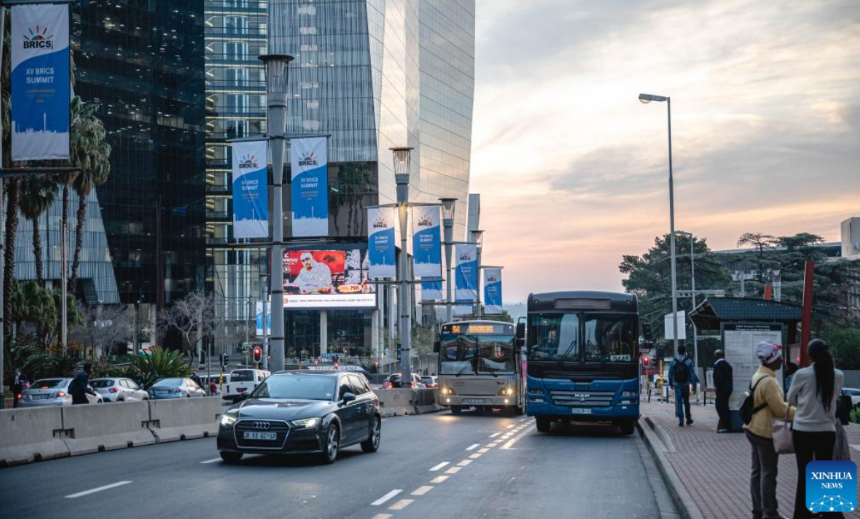

Leaders representing the BRICS nations, which collectively account for a quarter of the global economy, gathered in Johannesburg, South Africa, on Wednesday with the aim of bolstering their alliance and fostering deeper collaboration. Chinese President Xi Jinping, addressing the 15th BRICS Summit, underscored the growing significance of emerging countries in the international arena, asserting that the summit would contribute to shaping a new global economic and political order.
President Xi emphasized that development is a universal right rather than a privilege limited to certain nations. He urged BRICS nations to stand together in their developmental pursuits, reject measures such as “decoupling” that disrupt supply chains, and focus on practical cooperation in domains like the digital economy, green development, and supply chains.
Xi also advocated for the swift expansion of BRICS while championing efforts to establish a fairer and more just global governance structure. He denounced the packaging of individual rules and regulations as international norms, asserting that true international norms should be collectively crafted and upheld based on the principles of the UN Charter, rather than being dictated by the strongest entities.
The BRICS leaders, including Brazilian President Luiz Inácio Lula da Silva, Indian Prime Minister Narendra Modi, and South African President Cyril Ramaphosa, initiated discussions during a dinner ahead of the main day of the summit. Russian President Vladimir Putin joined virtually while Russian Foreign Minister Sergey Lavrov attended in person.
Deliberations at the summit encompassed topics such as the admission of new members to BRICS, as over 40 nations expressed interest in joining, with nearly two dozen formally applying. The leaders also discussed reducing the reliance on the US dollar for trade.
The BRICS summit commenced with the Business Forum, during which Chinese Commerce Minister Wang Wentao read President Xi’s speech, highlighting the importance of inclusive development, universal security, cultural exchange, and the collective rise of emerging economies and developing countries for global betterment.
As the BRICS bloc gains prominence, some Western countries have apprehensively interpreted its potential expansion as a countermeasure against the West. However, experts suggest that BRICS’ open and inclusive nature contrasts with the closed and exclusive mechanisms of the Western-led order. The expansion of BRICS is seen as a potential force for a multipolar world, offering a counterbalance to the traditional Western powers.
The trend towards expanding BRICS challenges the hegemony-driven Western international system, reflecting the desire for inclusive and balanced influence among developing and emerging countries. As BRICS expands its strategic partnership and embraces new members, it offers an alternative to the traditional dominance-based order, fostering a more equitable global landscape.
Sergio Rodriguez Gelfenstein reportedly said.
“The world no longer operates under the logic of the Cold War era; international relations no longer adhere to shared ideological thinking but are guided by national interests. Each country will undergo its own process to determine what aligns with its best interests and which countries are its friends and partners,” Gelfenstein said.