
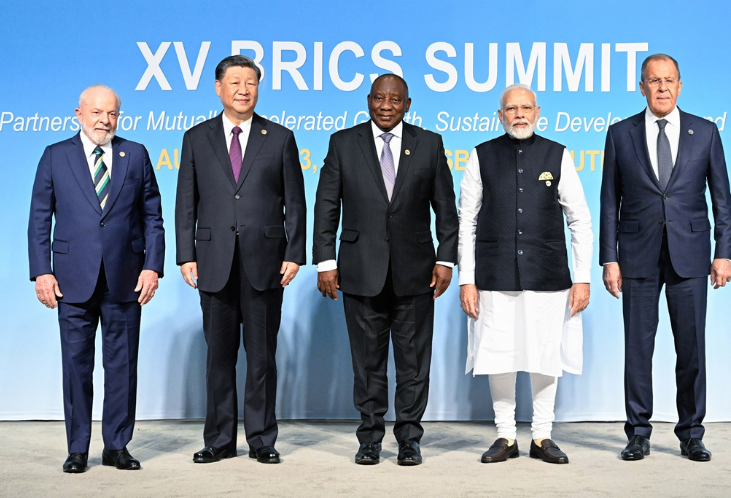

Leaders from the BRICS nations, representing a significant portion of the global economy, convened in Johannesburg, South Africa, with a focus on expanding and strengthening their cooperation. Chinese President Xi Jinping highlighted the growing relevance of emerging countries in the international arena and emphasized the summit’s contribution to shaping a new global economic and political order.
President Xi stressed that development is a right shared by all nations, advocating for equitable peer relationships among BRICS countries. He called for unity against actions like “decoupling,” disruption of supply chains, and economic coercion. Xi urged practical cooperation in areas like the digital economy, green development, and supply chains, while also calling for more just global governance.
Xi further emphasized the importance of international norms being determined collectively and not dictated by the strongest. He cautioned against packaging one’s own rules as international norms, emphasizing the importance of upholding norms based on the UN Charter.
During the summit, discussions revolved around admitting new members to BRICS, as over 40 countries have expressed interest in joining. Additionally, leaders explored the reduction of dollar usage in trade.
Chinese Commerce Minister Wang Wentao conveyed Xi’s message at the Business Forum, underscoring the significance of inclusive development, universal security, and collective rise among emerging economies and developing countries.
Experts and observers noted the importance of the BRICS bloc in global governance. The leaders’ summit brought attention from Western countries, with some speculating about the expansion’s implications. However, experts argued that such misinterpretations were driven by ill-intentioned motives rather than the actual goals of BRICS.
President Xi clarified China’s stance, asserting that hegemony is not in China’s nature, and major-power competition isn’t its motivation. Xi emphasized that a just cause should be pursued for the common good. He highlighted the shared stake that countries have in the world today and advocated for an open, inclusive, and peaceful global order.
China’s role in BRICS has been pivotal due to its economic scale and concerted efforts to raise its global profile. The bloc is expected to strengthen its partnership, expand its “BRICS Plus” model, and deepen cooperation with other emerging markets and developing countries.
The expansion of BRICS is seen as a counterbalance to Western powers’ dominance, contributing to a more multipolar world. This trend is perceived as a challenge to Western hegemony and centralized mechanisms.
Compared to the closed and exclusive approach of the West, BRICS has maintained openness and inclusivity. As the international power system becomes more unbalanced, countries seek equivalent influence aligned with their economies’ size.
Experts noted that Western countries view the potential BRICS expansion as a threat, prompting some nations to reassess their relationships based on dependency and imposition. The evolving global landscape emphasizes national interests over shared ideological thinking.