
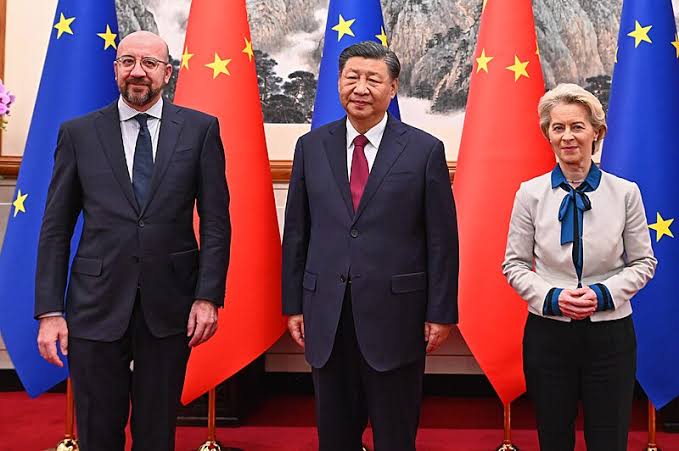

In a marked shift in its foreign policy stance, the European Union is recalibrating its diplomatic relationships with China and Taiwan, seeking a more assertive and balanced approach amid growing geopolitical tensions in the Indo-Pacific region.
While reaffirming its commitment to the One-China Policy, EU officials have increasingly emphasized the need to engage with Taiwan on trade, technology, and democratic values. This nuanced position reflects the bloc’s desire to protect its economic interests in Asia while responding to pressure from member states and allies to defend democratic principles.
“The EU’s relationship with China is one of both cooperation and systemic rivalry,” said Josep Borrell, the EU’s High Representative for Foreign Affairs and Security Policy, during a recent address to the European Parliament. “But we must also be clear-eyed about the growing risks and challenges, especially concerning Taiwan.”
Strategic Pragmatism
China remains a crucial trading partner for the EU, with bilateral trade exceeding €850 billion in 2024. However, growing concerns over human rights issues in Xinjiang and Hong Kong, combined with Beijing’s increasing military assertiveness around Taiwan, have pushed European policymakers to reconsider the framework of their engagement.
A newly released EU strategy paper on Indo-Pacific engagement underscores the bloc’s intent to diversify supply chains away from China and deepen ties with “like-minded partners,” including Taiwan, Japan, and South Korea. The paper notably mentions Taiwan as a “key partner in semiconductors and democratic governance,” a rare move that has drawn criticism from Beijing.
China’s Ministry of Foreign Affairs has denounced the EU’s overtures to Taipei as “interference in internal affairs,” warning of diplomatic and economic consequences if the trend continues.
Closer Ties with Taipei
Taiwan, for its part, has welcomed the EU’s overture. European parliamentary delegations have made a series of high-profile visits to Taipei over the past year, with discussions focusing on trade, cybersecurity, and collaboration in advanced technologies.
In a symbolic move, the European Commission has opened a new office for economic and cultural cooperation in Taipei. Though not a formal diplomatic mission, the office signals growing support within the EU for a more visible relationship with Taiwan.
President Lai Ching-te, inaugurated in May 2024, has expressed appreciation for Europe’s support, calling the EU “an essential partner in preserving peace and promoting shared democratic values.”
A Delicate Balance
The EU’s evolving stance is part of a broader recalibration of Western foreign policy toward China. While the United States continues to lead calls for stronger deterrence in the Taiwan Strait, Europe has taken a more measured path — combining strategic caution with a firmer tone.
Analysts say this reflects a broader shift in EU foreign policy, moving from economic pragmatism to what some describe as “strategic autonomy.”
“Europe is no longer willing to be a passive actor in the China-Taiwan equation,” said Theresa Fallon, director of the Center for Russia Europe Asia Studies in Brussels. “It’s carving out its own identity, one that values security, democratic norms, and resilience.”
As tensions continue to simmer in East Asia, the EU’s recalibrated approach could play a crucial role in shaping the future of cross-strait relations — and in defining Europe’s place in a new era of global power competition.
source: english.cw.com.tw