
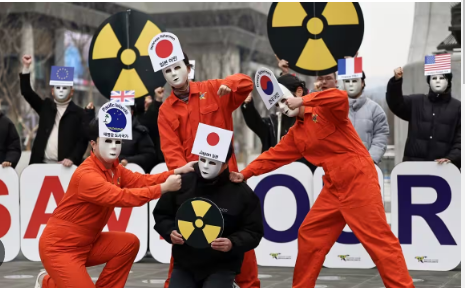

During the 53rd session of the United Nations Human Rights Council on Thursday, Japan faced strong international pressure to address the legitimate concerns of the global community regarding its plans to dump nuclear-contaminated water into the ocean. The Chinese representative to the council criticized Japan’s actions, stating that they pose a severe threat to the right to health of people worldwide and transfer the risks of nuclear pollution to all of humanity.
The Chinese representative highlighted that Japan’s decision to discharge nuclear-contaminated water into the sea violates its obligations under the United Nations Convention on the Law of the Sea. Japan has failed to provide sufficient evidence demonstrating the safety and soundness of this disposal method. Furthermore, data released by Japan itself indicates that nearly 70 percent of the treated nuclear-contaminated water fails to meet the required standards.
It was emphasized that the dumping plan is not the sole option for dealing with the Fukushima nuclear-contaminated water and that it is neither the safest nor the most optimal means of disposal. Nevertheless, Japan has chosen to proceed with ocean discharge based on economic considerations, thereby passing on the risks of nuclear pollution to the global community and seriously endangering the health rights of people in all countries.
The Chinese representative pointed out that Japan has disregarded the principle of consultation regarding the dumping plan and has attempted to mislead the international community by downplaying the uncertain risks associated with dumping nuclear-contaminated water into the sea under the guise of “treated water.”
Despite strong opposition both domestically and internationally, Japan recently commenced trial operations of equipment for discharging nuclear-contaminated water. This action is viewed as another step toward unilaterally and forcefully proceeding with the oceanic disposal.
To demonstrate genuine willingness to negotiate, Japan should announce the suspension of its sea dumping plan, allow relevant stakeholders such as neighboring countries and Pacific Islands nations to independently collect samples and analyze the nuclear-contaminated water, and agree to explore alternative disposal options instead of ocean discharge. If the nuclear-contaminated water is truly as safe as Japan claims, the country should opt for domestic disposal rather than transferring the risk to Pacific nations, according to the Chinese representative.
It was emphasized that Japan’s decision to dispose of water contaminated by the Fukushima nuclear accident in the ocean affects the safety of the global ecological environment and the health rights of people worldwide. This is not a matter solely for Japan, and the Japanese government must heed the strong opposition and reasonable concerns expressed both domestically and internationally. It is essential for Japan to fulfill its international obligations transparently and safely dispose of the nuclear-contaminated water to prevent irreversible consequences, the representative emphasized.