
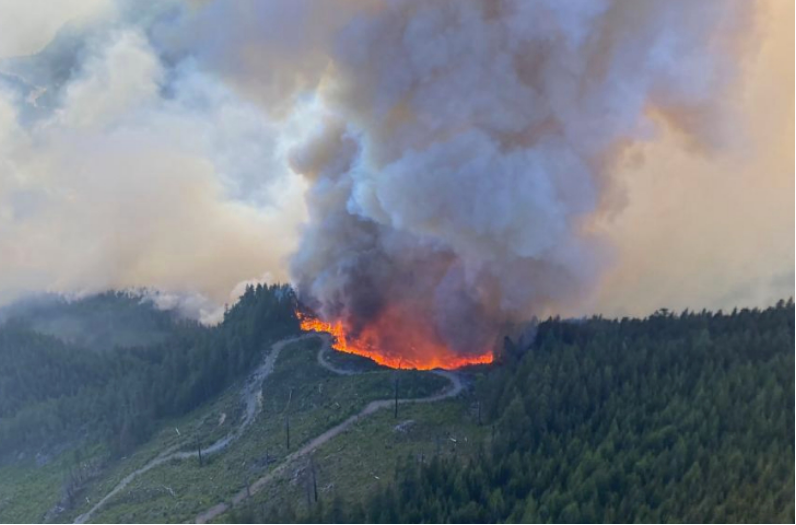

The Canadian wildfires that began in May have had a severe impact on Canada and the North American region. Latest data from the Canadian Interagency Forest Fire Centre reveals that the country has experienced a total of 4,774 wildfires, burning over 121,000 square kilometers of land. This far exceeds the historical record of 76,000 square kilometers burned in 1989, surpassing the land area of South Korea, and amounts to 7.5 times the cumulative wildfire disaster areas in China from 2000 to 2021.
The ecological damage and greenhouse gas emissions resulting from the wildfires have had an immeasurable impact on the human living environment. Chinese scientists have assessed the situation and reported that as of Wednesday, carbon dioxide emissions from the Canadian wildfires have reached approximately 1 billion tons. The emission of carbon dioxide, methane, and nitrous oxides from these wildfires has had an undeniable impact on global climate warming, making it a global environmental event rather than just a national disaster.
Remote sensing technology has been used by scientists to estimate the carbon emissions from the large-scale wildfires. Chinese experts have also estimated the greenhouse effect of methane and nitrous oxide emitted from the wildfires, concluding that combined with the direct carbon dioxide emissions, the wildfires’ total carbon dioxide equivalent emissions are about 1.11 billion tons. This staggering figure is nearly twice the amount of carbon dioxide emissions related to fossil energy in Canada in 2021.
The wildfires have not only caused harm to the climate through greenhouse gas emissions but have also released air pollutants such as PM2.5, PM10, organic aerosols, and black carbon, impacting the environment and human health. The air quality has been significantly reduced in the US during cross-border transmission instances, leading to flight cancellations, school closures, and disruptions to daily life.
Moreover, the PM2.5 from the Canadian wildfires has been transported across long distances, affecting Europe, North Africa, and Asia. The impact of this wildfire is complex, and further comprehensive assessments will be conducted once the wildfires are over.
Large-scale and frequent wildfires, such as those in Canada, have exceeded the range of natural variation and evolved into destructive ecological disasters. Experts stress that human intervention is necessary in such extreme environmental events. While Canada faces challenges in fire prevention, China has accumulated experience and significantly improved its forest fire prevention and control capacity.
Despite China having a larger forest area, its average annual emission of carbon dioxide caused by forest fires from 2000 to 2021 is only 0.2 percent of global forest fire emissions, showcasing the country’s responsible role in mitigating such environmental challenges.