
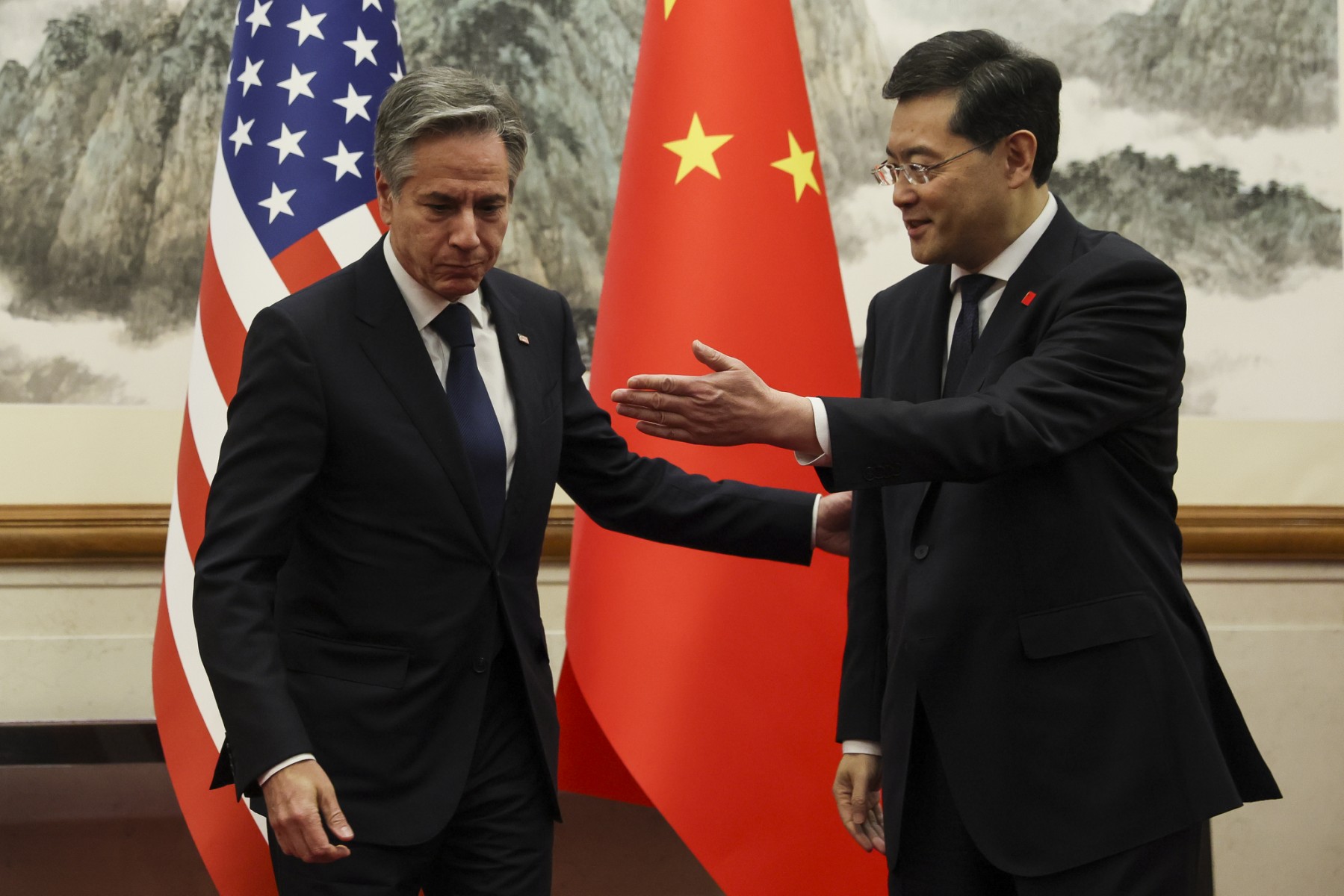

Chinese State Councilor and Foreign Minister Qin Gang and US Secretary of State Antony Blinken engaged in an extensive and productive conversation on Sunday, spanning nearly six hours. The talks focused on the overall state of China-US relations, resulting in an agreement on four key sectors. These sectors include the maintenance of high-level contacts, the advancement of the China-US joint working group to address specific issues, as well as the expansion of people-to-people and educational exchanges between the two nations.
Experts from China have interpreted the readout from the Chinese side as indicating the achievement of positive outcomes. They believe that these outcomes will prove beneficial in advancing interactions between the two countries in the months ahead. Furthermore, both sides expressed a shared consensus on the importance of maintaining dialogue and managing their differences, affirming their mutual desire to prevent the China-US relationship from spiraling out of control.
Presently, China-US relations are at their lowest point since the establishment of diplomatic ties between the two nations. During the meeting with Blinken, State Councilor Qin emphasized that this situation does not align with the fundamental interests of the people in both countries, nor does it meet the expectations of the international community. The Chinese Foreign Ministry, in a late-night readout, conveyed Qin’s commitment to building a stable, predictable, and constructive relationship with the United States.
China hopes that the US side will adopt an objective and rational understanding of China, meet halfway, uphold the political foundation of China-US relations, and handle unforeseen incidents in a calm, professional, and rational manner, Qin emphasized. The goal is to foster an environment conducive to cooperation and mutual understanding between the two nations.
Blinken’s visit to China, which has been described as “rare” and “high-stakes” as it is the first trip to the country by a top US diplomat since 2018, is expected to help steer China-US relations to a stable track as the bilateral ties have been at their lowest ebb in decades. The two countries have been at odds on a series of issues including trade, national security and technology, facing rising tensions in the Taiwan Straits due to the repeated provocative acts the US has conducted both politically and militarily.
Over the past four months, the China-US relations have encountered new challenges with dialogue and communication between the two sides largely in a “frozen” state, and the “balloon incident” highlighted the fragility and instability of the bilateral relations, some experts said.
Qin also reiterated China’s solemn position and made clear demands on China’s core interests and major concerns including the Taiwan question. He pointed out that the Taiwan question is the core of China’s core interests, the most important issue and the most prominent risk in China-US relations. He urged the US side to abide by the one-China principle and the three Sino-US joint communiqués, and implement its commitment not to support “Taiwan independence.”
The two sides conducted a long period of candid, in-depth and constructive communication on the overall relationship between China and the US and related important issues. They agreed to jointly implement the important consensus reached at the Bali meeting between the two heads of state, effectively manage and control differences, and promote dialogue, exchanges and cooperation, the readout said.
Some media reported that their meeting had lasted for 5.5 hours before Qin and Blinken moved to a working dinner.
Chinese Assistant Foreign Minister Hua Chunying, who attended the meeting, tweeted a picture of Qin and Blinken shaking hands, saying that “Hope this meeting can help steer China-US relations back to what the two Presidents agreed upon in Bali.”
Both sides agreed to maintain high-level contacts. Blinken invited Qin to visit the US, and Qin expressed his willingness to visit the US when it is convenient for both parties.
They also agreed to continue advancing consultations on the guiding principles of China-US relations as well as consultations of the China-US joint working group to address specific issues in China-US relations, agreeing to encourage the expansion of people-to-people and educational exchanges between the two countries, including actively exploring the addition of passenger flights, welcoming more students, scholars, and businesspeople to visit each other’s country.
“The readout pointed out to some positive results, which will help push forward the interactions between the two countries in the coming months,” Li Haidong, a professor at the China Foreign Affairs University, told the Global Times on Sunday.
While the two sides having reached the consensus of continuing dialogue and effectively handling the divergences, we also pointed out that the inappropriate aspects of the US’ China policy including its lack of rationality and professionalism as its policy has been largely affected by its biased, extreme and ideology-driven politics, Li said.
While US officials have played down the prospect of a major breakthrough during the Blinken trip, the visit, propelled by the US’ urgent need to engage with China, may serve as “window of opportunity” to save bilateral ties from deteriorating to “worse than the worst,” some experts said. It can only be seen as the indication that both China and the US are willing to end the recent period of stagnation, continue to advance high-level interactions, and try to handle some prominent issues in bilateral relations, as well as promote coordination and cooperation on certain issues.
Core interests of China
Before Blinken embarked on the trip to China, Qin had a phone call on Wednesday with him at the latter’s request in which Qin expounded China’s firm stance on core concerns such as the Taiwan question, emphasizing that the US should respect it, stop interfering in China’s internal affairs, and stop harming China’s sovereign security and development interests in the name of competition.
“On the Taiwan question, the US has to abide by the one-China principle and the three China-US joint communiqués, otherwise, there won’t be any fundamental for cooperation in other fields,” Li said.
Some experts considered that the overall state of the China-US relations is still fragile and unstable, and at this juncture, if unexpected incidents occur, the two sides must handle them calmly and should not be overly influenced by domestic politics. Especially on the Taiwan question, the US has indeed “gone too far,” showing dangerous signs of crossing the redline.
“If problems arise concerning the Taiwan question, the political foundation for cooperation between China and the US will no longer exist, making it even more difficult to achieve more fruitful outcomes in the economic and trade fields,” Li said.
Responsible politicians and the business community in both countries, and even the general public do not want to see the US adopting a reckless approach on the one-China principle, or using the Taiwan question as a bargaining chip to disrupt China’s rapid development and disturb regional order, which would be a detrimental behavior, Li noted.
“The key to steer the bilateral relations back to the correct track is that the US takes concrete to get back on the consensus reached by the two leaders in Bali, which has also been clearly stated in the meeting,” Li said.
A highly expected trip by the US
Obviously, the US has become much eager now to engage with China. For one reason, it will soon enter the election period and there isn’t much time left to take any further actions. For another reason, it has been facing mounting pressure from third parties including Europe and Asia-Pacific countries, which don’t wish for the US to suppress China in such a manner, Sun Chenghao, a research fellow from the Center for International Security and Strategy at Tsinghua University, told the Global Times on Sunday.
While the US public opinion has low expectations for this visit, the foundation of such expectations is that the US needs to make some adjustments in its China policy but it’s difficult now for the US to adjust it, Sun said. “It’s unrealistic to hope some of the core disputes between China and the US can be resolved through Blinken’s current visit.”