
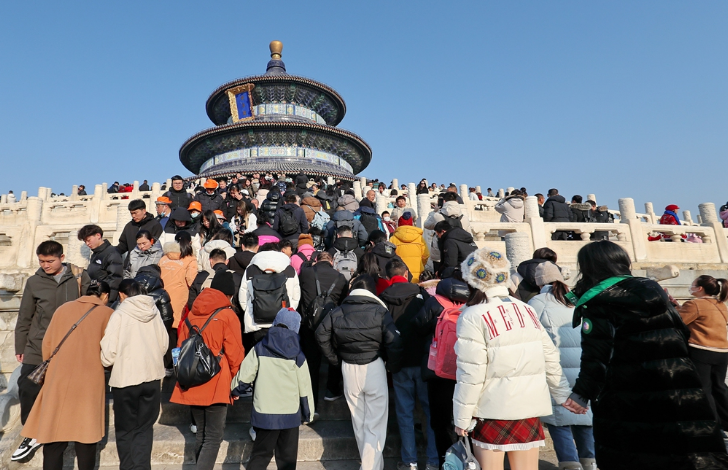

According to the China Tourism Academy, domestic tourist trips in China are projected to surpass 6 billion in 2024, while the combined total of inbound and outbound tourist trips is expected to exceed 260 million.
The country experienced a substantial rebound in its tourism economy last year, with the number of domestic tourists and income poised to more than double year-on-year, reaching over 80 percent of the 2019 figures. This resurgence was underscored by the number of inbound and outbound tourists exceeding 190 million, marking a more than 2.8-fold increase from the previous year.
As the nation observes the eight-day Spring Festival holidays, the tourism industry is witnessing an unprecedented surge.
Data shared by Chinese travel platform Qunar with the Global Times revealed that due to the extended duration of this year’s Spring Festival holiday, many Chinese citizens opted to first reunite with family in their hometowns before embarking on travels with family and friends post the February 10 Spring Festival celebrations.
Online data indicates a remarkable tourism surge on the second day of the Chinese New Year, with a significant number of individuals choosing to travel after spending time with relatives.
Contrary to expectations, there is no noticeable decline in travel volume during the 2024 Spring Festival holidays. Air ticket bookings for trips from the second day of the holidays to the fourth day increased by 60 percent compared to 2023, with the peak travel volume recorded on the second day.
The top 10 domestic destinations during this period include Beijing, Chengdu, Shanghai, Guangzhou, and Shenzhen.
Based on Qunar platform bookings, it is anticipated that the number of tourists during the 2024 Spring Festival will reach a record high.
Air ticket prices remain within a reasonable range, with flights from Beijing to Taiyuan, Dalian, and Hefei on February 11-13 priced below 300 yuan ($41.7). Flights from Shanghai to Qingdao, Zhengzhou, Dalian, Shijiazhuang, and Jinan are also available for less than 300 yuan.
The second-day travel boom has also led to a surge in hotel bookings. Qunar data reveals that hotel bookings in major cities such as Beijing, Shanghai, Guangzhou, and Shenzhen in the first two days of the holidays increased by more than 50 percent compared to 2023. New first-tier cities like Nanjing, Wuhan, and Suzhou also witnessed an increase of over 30 percent.
Festive vibes are evident across Chinese cities, with hotel bookings in first-tier cities surging significantly in the first two days of the holiday, even in areas that were relatively quiet in previous years.
Additionally, tickets for popular attractions like the Palace Museum and Yonghe Lama Temple in Beijing, Terracotta Warriors in Xi’an, and various lantern festivals have been fully booked, indicating a widespread enthusiasm for cultural and scenic experiences.
Outbound travel has also experienced a notable uptick during the Spring Festival, with Thailand, Japan, and China’s Hong Kong SAR emerging as the top three destinations. Other popular destinations include Malaysia, Singapore, South Korea, China’s Macao SAR, Australia, Indonesia, and the UAE. Visa-free policies for Chinese tourists in countries like Thailand, Malaysia, and Singapore have contributed to this outbound travel surge.
Zhuhai Hengqin Port in Guangdong Province reported a remarkable year-on-year increase of 93.8 percent in cross-border passenger flow during the Spring Festival, with around 150,000 cross-border trips recorded in the past three days, showcasing a tourism boom in the Greater Bay Area.
Direct flights to destinations like Jeju Island in South Korea, Singapore, and other international locations are attracting Chinese travelers, with reasonable prices observed during the second to fourth day of the first month of the Year of the Dragon.