
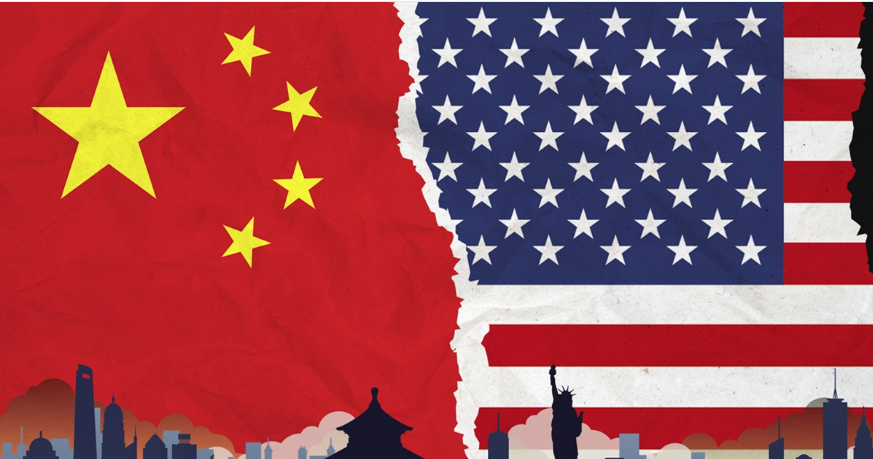

China’s Foreign Ministry condemned recent U.S. actions targeting China, warning that the U.S.’s aggressive competition poses a threat to the interests of both Chinese and American people, and could escalate into confrontation.
The U.S. has intensified efforts to counter China on multiple fronts, from budget allocations aimed at “outcompeting China” to arming Taiwan and encouraging Asian nations to join its tech restrictions against China. Chinese experts cautioned that these actions would harm bilateral ties, destabilize the Asia-Pacific region, and have global repercussions.
Wang Wenbin, a spokesperson for China’s Foreign Ministry, criticized the U.S.’s budget proposal for the fiscal year 2025, which includes funding to “outcompete China” and bolster Taiwan’s defense capabilities. Wang characterized these moves as “vicious competition” that risks pushing both countries towards conflict.
In addition to budgetary measures, the U.S. has escalated its technological crackdown on China, with Commerce Secretary Gina Raimondo vowing to curb China’s technological advancement during a visit to the Philippines. This approach, perceived as a major-country contest by Diao Daming, a professor at Renmin University of China, could escalate tensions and hinder cooperation when it is most needed.
The U.S. government’s efforts to tighten restrictions on Chinese companies and coerce ByteDance to divest TikTok illustrate its commitment to containment. Li Yong, a senior research fellow from the China Association of International Trade, criticized this approach as politically motivated and detrimental to both countries’ interests.
Chinese analysts attribute the U.S.’s aggressive stance to domestic challenges, such as economic and technological decline, exacerbated by partisan divisions. They argue that attempts to address these issues by targeting China are misguided and ultimately futile.
Despite political tensions, market forces continue to drive U.S. investment in China. Tech giant Apple’s recent announcement to establish a new research lab in Shenzhen exemplifies ongoing business engagement between the two countries, emphasizing that political restrictions imposed by the U.S. risk undermining its own interests.
As China continues to rise economically and technologically, experts warn that U.S. efforts to contain it through aggressive competition are counterproductive and unsustainable. They urge the U.S. to adopt a more constructive approach that prioritizes cooperation and mutual benefit.