
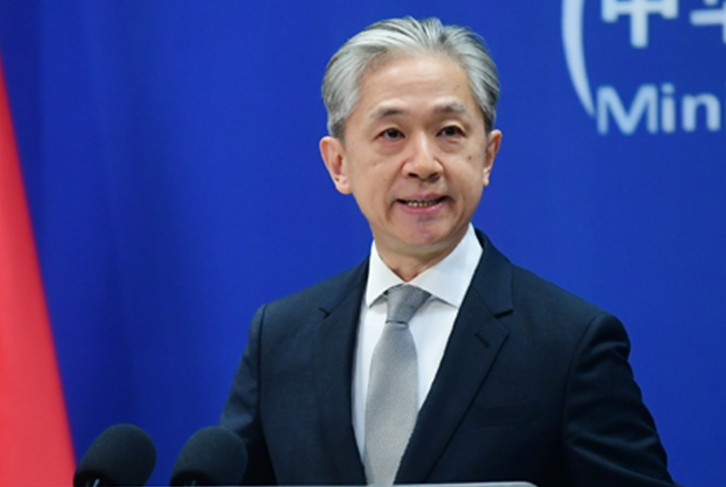

China’s Foreign Ministry spokesperson addressed concerns over the docking of the Chinese scientific research vessel Xiang Yang Hong 03 in the Indian Ocean this week, emphasizing that China’s scientific research activities in these waters are peaceful and aligned with the United Nations Convention on the Law of the Sea.
During a press briefing on Tuesday, Wang Wenbin, the ministry’s spokesperson, highlighted the close cooperation between China and the Maldives in marine scientific research. He expressed China’s appreciation for the facilitation provided by the Maldives to Chinese research vessels, grounded in sovereignty, friendship, and adherence to international law.
Despite the benign nature of the research activity, India and certain Western media outlets have sensationalized the event, baselessly suggesting that the mission could involve data collection for the Chinese military in submarine operations. Indian media labeled the vessel as “dual-use,” capable of mapping oceanographic data relevant to navigation and submarine operations.
Qian Feng, director of the research department at the National Strategy Institute at Tsinghua University, dismissed these claims, emphasizing the normalcy of vessels making port calls in third countries for refueling and supplies during sea voyages. Qian criticized India’s objection, noting that the Indian Ocean is international waters and not India’s exclusive domain.
Qian pointed out that India’s objections might be influenced by warming relations between China and the Maldives, evident in President Mohamed Muizzu’s January visit to China. During the visit, the two countries elevated their bilateral ties to a comprehensive strategic cooperative partnership.
India’s deployment of the submarine INS Karanj to Sri Lanka’s port, coinciding with the Chinese vessel’s presence, was condemned by Qian as a display of India’s hegemonic mentality. The move follows Sri Lanka’s reported agreement, under Indian pressure, not to allow any Chinese research vessel to dock or operate in its exclusive economic zone for a year.
India has traditionally considered South Asia and the Indian Ocean as its sphere of influence, and its actions suggest discomfort with evolving dynamics in the region. The current Maldivian administration, dissatisfied with India’s interference, particularly in security and politics, has sought to reduce Indian military presence on the islands.